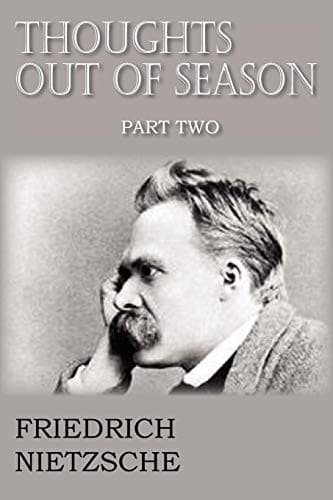
Thoughts Out of Season, Part IINietzsche, Friedrich Wilhelm
PhilosophyPhilosophy
Thoughts Out of Season, Part II
Nietzsche, Friedrich Wilhelm
History -- Study and teaching; Schopenhauer, Arthur, 1788-1860
This however must be added. The thought of being Epigoni, that is
often a torture, can yet create a spring of hope for the future, to
the individual as well as the people: so far, that is, as we can
regard ourselves as the heirs and followers of the marvellous
classical power, and see therein both our honour and our spur. But
not as the late and bitter fruit of a powerful stock, giving that
stock a further spell of cold life, as antiquaries and grave-diggers.
Such late-comers live truly an ironical existence. Annihilation
follows their halting walk on tiptoe through life. They shudder
before it in the midst of their rejoicing over the past. They are
living memories, and their own memories have no meaning; for there
are none to inherit them. And thus they are wrapped in the melancholy
thought that their life is an injustice, which no future life can set
right again.
Suppose that these antiquaries, these late arrivals, were to change
their painful ironic modesty for a certain shamelessness. Suppose we
heard them saying, aloud, "The race is at its zenith, for it has
manifested itself consciously for the first time." We should have a
comedy, in which the dark meaning of a certain very celebrated
philosophy would unroll itself for the benefit of German culture. I
believe there has been no dangerous turning-point in the progress of
German culture in this century that has not been made more dangerous
by the enormous and still living influence of this Hegelian
philosophy. The belief that one is a late-comer in the world is,
anyhow, harmful and degrading: but it must appear frightful and
devastating when it raises our late-comer to godhead, by a neat turn
of the wheel, as the true meaning and object of all past creation,
and his conscious misery is set up as the perfection of the world's
history. Such a point of view has accustomed the Germans to talk of a
"world-process," and justify their own time as its necessary result.
And it has put history in the place of the other spiritual powers,
art and religion, as the one sovereign; inasmuch as it is the "Idea
realising itself," the "Dialectic of the spirit of the nations," and
the "tribunal of the world."
Public-domain text, read in full here on John Shaqi.
Reviews
Reviews
No reviews yet
Be the first to share your thoughts on this work.
Join the Discussion
Join the discussion
Sign in to leave a comment or review.
Sign InorCreate an account