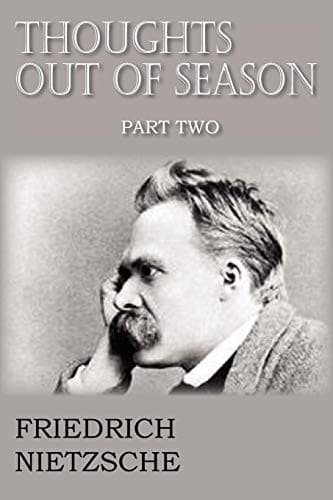
Thoughts Out of Season, Part IINietzsche, Friedrich Wilhelm
PhilosophyPhilosophy
Thoughts Out of Season, Part II
Nietzsche, Friedrich Wilhelm
History -- Study and teaching; Schopenhauer, Arthur, 1788-1860
O thou too proud European of the nineteenth century, art thou not
mad? Thy knowledge does not complete Nature, it only kills thine own
nature! Measure the height of what thou knowest by the depths of thy
power to _do_. Thou climbest the sunbeams of knowledge up towards
heaven--but also down to Chaos. Thy manner of going is fatal to thee;
the ground slips from under thy feet into the unknown; thy life has
no other stay, but only spider's webs that every new stroke of thy
knowledge tears asunder.--But not another serious word about this,
for there is a lighter side to it all.
The moralist, the artist, the saint and the statesman may well be
troubled, when they see that all foundations are breaking up in mad
unconscious ruin, and resolving themselves into the ever flowing
stream of becoming; that all creation is being tirelessly spun into
webs of history by the modern man, the great spider in the mesh of
the world-net. We ourselves may be glad for once in a way that we see
it all in the shining magic mirror of a philosophical parodist, in
whose brain the time has come to an ironical consciousness of itself,
to a point even of wickedness, in Goethe's phrase. Hegel once said,
"when the spirit makes a fresh start, we philosophers are at hand."
Our time did make a fresh start--into irony, and lo! Edward von
Hartmann was at hand, with his famous Philosophy of the
Unconscious--or, more plainly, his philosophy of unconscious irony.
We have seldom read a more jovial production, a greater philosophical
joke than Hartmann's book. Any one whom it does not fully enlighten
about "becoming," who is not swept and garnished throughout by it, is
ready to become a monument of the past himself. The beginning and end
of the world-process, from the first throb of consciousness to its
final leap into nothingness, with the task of our generation settled
for it;--all drawn from that clever fount of inspiration, the
Unconscious, and glittering in Apocalyptic light, imitating an honest
seriousness to the life, as if it were a serious philosophy and not a
huge joke,--such a system shows its creator to be one of the first
philosophical parodists of all time. Let us then sacrifice on his
altar, and offer the inventor of a true universal medicine a lock of
hair, in Schleiermacher's phrase. For what medicine would be more
salutary to combat the excess of historical culture than Hartmann's
parody of the world's history?
Public-domain text, read in full here on John Shaqi.
Reviews
Reviews
No reviews yet
Be the first to share your thoughts on this work.
Join the Discussion
Join the discussion
Sign in to leave a comment or review.
Sign InorCreate an account