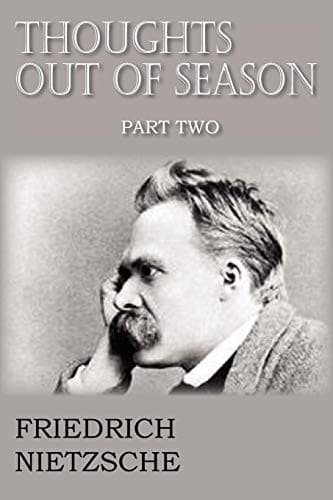
Thoughts Out of Season, Part IINietzsche, Friedrich Wilhelm
PhilosophyPhilosophy
Thoughts Out of Season, Part II
Nietzsche, Friedrich Wilhelm
History -- Study and teaching; Schopenhauer, Arthur, 1788-1860
I know that such hopeful beings understand all these truisms from
within, and can translate them into a doctrine for their own use,
through their personal experience. To the others there will appear,
in the meantime, nothing but a row of covered dishes, that may
perhaps seem empty: until they see one day with astonished eyes that
the dishes are full, and that all ideas and impulses and passions are
massed together in these truisms that cannot lie covered for long. I
leave those doubting ones to time, that brings all things to light;
and turn at last to that great company of hope, to tell them the way
and the course of their salvation, their rescue from the disease of
history, and their own history as well, in a parable; whereby they
may again become healthy enough to study history anew, and under the
guidance of life make use of the past in that threefold
way--monumental, antiquarian, or critical. At first they will be more
ignorant than the "educated men" of the present: for they will have
unlearnt much and have lost any desire even to discover what those
educated men especially wish to know: in fact, their chief mark from
the educated point of view will be just their want of science; their
indifference and inaccessibility to all the good and famous things.
But at the end of the cure, they are men again and have ceased to be
mere shadows of humanity. That is something; there is yet hope, and
do not ye who hope laugh in your hearts?
How can we reach that end? you will ask. The Delphian god cries his
oracle to you at the beginning of your wanderings, "Know thyself." It
is a hard saying: for that god "tells nothing and conceals nothing
but merely points the way," as Heraclitus said. But whither does he
point?
In certain epochs the Greeks were in a similar danger of being
overwhelmed by what was past and foreign, and perishing on the rock
of "history." They never lived proud and untouched. Their "culture"
was for a long time a chaos of foreign forms and ideas,--Semitic,
Babylonian, Lydian and Egyptian,--and their religion a battle of all
the gods of the East; just as German culture and religion is at
present a death-struggle of all foreign nations and bygone times. And
yet, Hellenic culture was no mere mechanical unity, thanks to that
Delphic oracle. The Greeks gradually learned to organise the chaos,
by taking Apollo's advice and thinking back to themselves, to their
own true necessities, and letting all the sham necessities go. Thus
they again came into possession of themselves, and did not remain
long the Epigoni of the whole East, burdened with their inheritance.
After that hard fight, they increased and enriched the treasure they
had inherited by their obedience to the oracle, and they became the
ancestors and models for all the cultured nations of the future.
Public-domain text, read in full here on John Shaqi.
Reviews
Reviews
No reviews yet
Be the first to share your thoughts on this work.
Elsewhere in the archive
Join the Discussion
Join the discussion
Sign in to leave a comment or review.
Sign InorCreate an account