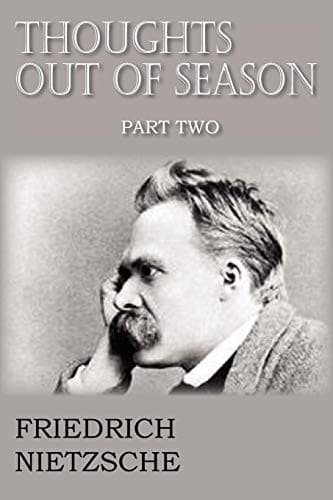
Thoughts Out of Season, Part IINietzsche, Friedrich Wilhelm
PhilosophyPhilosophy
Thoughts Out of Season, Part II
Nietzsche, Friedrich Wilhelm
History -- Study and teaching; Schopenhauer, Arthur, 1788-1860
This is a parable for each one of us: he must organise the chaos in
himself by "thinking himself back" to his true needs. He will want
all his honesty, all the sturdiness and sincerity in his character to
help him to revolt against second-hand thought, second-hand learning,
second-hand action. And he will begin then to understand that culture
can be something more than a "decoration of life"--a concealment and
disfiguring of it, in other words; for all adornment hides what is
adorned. And thus the Greek idea, as against the Roman, will be
discovered in him, the idea of culture as a new and finer nature,
without distinction of inner and outer, without convention or
disguise, as a unity of thought and will, life and appearance. He
will learn too, from his own experience, that it was by a greater
force of moral character that the Greeks were victorious, and that
everything which makes for sincerity is a further step towards true
culture, however this sincerity may harm the ideals of education that
are reverenced at the time, or even have power to shatter a whole
system of merely decorative culture.
SCHOPENHAUER AS EDUCATOR.
I.
When the traveller, who had seen many countries and nations and
continents, was asked what common attribute he had found everywhere
existing among men, he answered, "They have a tendency to sloth."
Many may think that the fuller truth would have been, "They are all
timid." They hide themselves behind "manners" and "opinions." At
bottom every man knows well enough that he is a unique being, only
once on this earth; and by no extraordinary chance will such a
marvellously picturesque piece of diversity in unity as he is, ever
be put together a second time. He knows this, but hides it like an
evil conscience;--and why? From fear of his neighbour, who looks for
the latest conventionalities in him, and is wrapped up in them
himself. But what is it that forces the man to fear his neighbour, to
think and act with his herd, and not seek his own joy? Shyness
perhaps, in a few rare cases, but in the majority it is idleness, the
"taking things easily," in a word the "tendency to sloth," of which
the traveller spoke. He was right; men are more slothful than timid,
and their greatest fear is of the burdens that an uncompromising
honesty and nakedness of speech and action would lay on them. It is
only the artists who hate this lazy wandering in borrowed manners and
ill-fitting opinions, and discover the secret of the evil conscience,
the truth that each human being is a unique marvel. They show us, how
in every little movement of his muscles the man is an individual
self, and further--as an analytical deduction from his individuality--
a beautiful and interesting object, a new and incredible phenomenon
(as is every work of nature), that can never become tedious. If the
great thinker despise mankind, it is for their laziness; they seem
mere indifferent bits of pottery, not worth any commerce or
improvement.
Public-domain text, read in full here on John Shaqi.
Reviews
Reviews
No reviews yet
Be the first to share your thoughts on this work.
Elsewhere in the archive
Join the Discussion
Join the discussion
Sign in to leave a comment or review.
Sign InorCreate an account