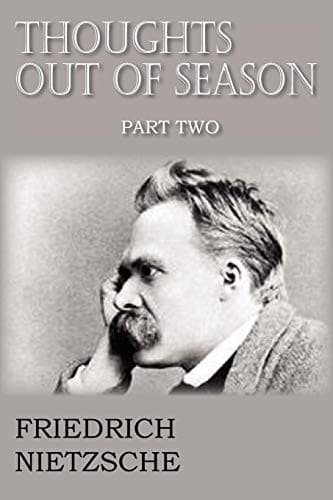
Thoughts Out of Season, Part IINietzsche, Friedrich Wilhelm
PhilosophyPhilosophy
Thoughts Out of Season, Part II
Nietzsche, Friedrich Wilhelm
History -- Study and teaching; Schopenhauer, Arthur, 1788-1860
To fix this degree and the limits to the memory of the past, if it is
not to become the gravedigger of the present, we must see clearly how
great is the "plastic power" of a man or a community or a culture; I
mean the power of specifically growing out of one's self, of making
the past and the strange one body with the near and the present, of
healing wounds, replacing what is lost, repairing broken moulds.
There are men who have this power so slightly that a single sharp
experience, a single pain, often a little injustice, will lacerate
their souls like the scratch of a poisoned knife. There are others,
who are so little injured by the worst misfortunes, and even by their
own spiteful actions, as to feel tolerably comfortable, with a fairly
quiet conscience, in the midst of them,--or at any rate shortly
afterwards. The deeper the roots of a man's inner nature, the better
will he take the past into himself; and the greatest and most
powerful nature would be known by the absence of limits for the
historical sense to overgrow and work harm. It would assimilate and
digest the past, however foreign, and turn it to sap. Such a nature
can forget what it cannot subdue; there is no break in the horizon,
and nothing to remind it that there are still men, passions, theories
and aims on the other side. This is a universal law; a living thing
can only be healthy, strong and productive within a certain horizon:
if it be incapable of drawing one round itself, or too selfish to
lose its own view in another's, it will come to an untimely end.
Cheerfulness, a good conscience, belief in the future, the joyful
deed, all depend, in the individual as well as the nation, on there
being a line that divides the visible and clear from the vague and
shadowy: we must know the right time to forget as well as the right
time to remember; and instinctively see when it is necessary to feel
historically, and when unhistorically. This is the point that the
reader is asked to consider; that the unhistorical and the historical
are equally necessary to the health of an individual, a community,
and a system of culture.
Public-domain text, read in full here on John Shaqi.
Reviews
Reviews
No reviews yet
Be the first to share your thoughts on this work.
Join the Discussion
Join the discussion
Sign in to leave a comment or review.
Sign InorCreate an account