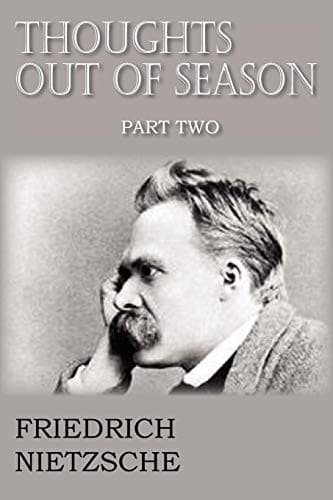
Thoughts Out of Season, Part IINietzsche, Friedrich Wilhelm
PhilosophyPhilosophy
Thoughts Out of Season, Part II
Nietzsche, Friedrich Wilhelm
History -- Study and teaching; Schopenhauer, Arthur, 1788-1860
established forms and ordinances, if we wish to bring the higher
truth and order, that lives in him, to the light. The "truth,"
however, of which we hear so much from our professors, seems to be a
far more modest being, and no kind of disturbance is to be feared
from her; she is an easy-going and pleasant creature, who is
continually assuring the powers that be that no one need fear any
trouble from her quarter: for man is only "pure reason." And
therefore I will say, that philosophy in Germany has more and more to
learn not to be "pure reason": and it may well take as its model
"Schopenhauer the man."
It is no less than a marvel that he should have come to be this human
kind of example: for he was beset, within and without, by the most
frightful dangers, that would have crushed and broken a weaker
nature. I think there was a strong likelihood of Schopenhauer the man
going under, and leaving at best a residue of "pure reason": and only
"at best"--it was more probable that neither man nor reason would
survive.
A modern Englishman sketches the most usual danger to extraordinary
men who live in a society that worships the ordinary, in this
manner:--"Such uncommon characters are first cowed, then become sick
and melancholy, and then die. A Shelley could never have lived in
England: a race of Shelleys would have been impossible." Our
Hölderlins and Kleists were undone by their unconventionality, and
were not strong enough for the climate of the so-called German
culture; and only iron natures like Beethoven, Goethe, Schopenhauer
and Wagner could hold out against it. Even in them the effect of this
weary toiling and moiling is seen in many lines and wrinkles; their
breathing is harder and their voice is forced. The old diplomatist
who had only just seen and spoken to Goethe, said to a friend--"Voilà
un homme qui a eu de grands chagrins!" which Goethe translated to
mean "That is a man who has taken great pains in his life." And he
adds, "If the trace of the sorrow and activity we have gone through
cannot be wiped from our features, it is no wonder that all that
survives of us and our struggles should bear the same impress." And
this is the Goethe to whom our cultured Philistines point as the
happiest of Germans, that they may prove their thesis, that it must
be possible to be happy among them--with the unexpressed corollary
that no one can be pardoned for feeling unhappy and lonely among
them. Hence they push their doctrine, in practice, to its merciless
conclusion, that there is always a secret guilt in isolation. Poor
Schopenhauer had this secret guilt too in his heart, the guilt of
cherishing his philosophy more than his fellow-men; and he was so
unhappy as to have learnt from Goethe that he must defend his
philosophy at all costs from the neglect of his contemporaries, to
save its very existence: for there is a kind of Grand Inquisitor's
Censure in which the Germans, according to Goethe, are great adepts:
it is called--inviolable silence.
Public-domain text, read in full here on John Shaqi.
Reviews
Reviews
No reviews yet
Be the first to share your thoughts on this work.
Elsewhere in the archive
Join the Discussion
Join the discussion
Sign in to leave a comment or review.
Sign InorCreate an account