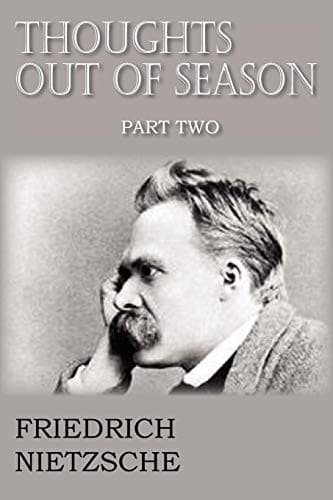
Thoughts Out of Season, Part IINietzsche, Friedrich Wilhelm
PhilosophyPhilosophy
Thoughts Out of Season, Part II
Nietzsche, Friedrich Wilhelm
History -- Study and teaching; Schopenhauer, Arthur, 1788-1860
I have been describing nothing but the first, almost physiological,
impression made upon me by Schopenhauer, the magical emanation of
inner force from one plant of Nature to another, that follows the
slightest contact. Analysing it, I find that this influence of
Schopenhauer has three elements, his honesty, his joy, and his
consistency. He is honest, as speaking and writing for himself alone;
joyful, because his thought has conquered the greatest difficulties;
consistent, because he cannot help being so. His strength rises like
a flame in the calm air, straight up, without a tremor or deviation.
He finds his way, without our noticing that he has been seeking it:
so surely and cleverly and inevitably does he run his course, as if
by some law of gravitation. If any one have felt what it means to
find, in our present world of Centaurs and Chimæras, a single-hearted
and unaffected child of nature who moves unconstrained on his own
road, he will understand my joy and surprise in discovering
Schopenhauer: I knew in him the educator and philosopher I had so
long desired. Only, however, in his writings: which was a great loss.
All the more did I exert myself to see behind the book the living man
whose testament it was, and who promised his inheritance to such as
could, and would, be more than his readers--his pupils and his sons.
III.
I get profit from a philosopher, just so far as he can be an example
to me. There is no doubt that a man can draw whole nations after him
by his example; as is shown by Indian history, which is practically
the history of Indian philosophy. But this example must exist in his
outward life, not merely in his books; it must follow the way of the
Grecian philosophers, whose doctrine was in their dress and bearing
and general manner of life rather than in their speech or writing. We
have nothing yet of this "breathing testimony" in German
philosophical life; the spirit has, apparently, long completed its
emancipation, while the flesh has hardly begun; yet it is foolish to
think that the spirit can be really free and independent when this
victory over limitation--which is ultimately a formative limiting of
one's self--is not embodied anew in every look and movement. Kant
held to his university, submitted to its regulations, and belonged,
as his colleagues and students thought, to a definite religious
faith: and naturally his example has produced, above all, University
professors of philosophy. Schopenhauer makes small account of the
learned tribe, keeps himself exclusive, and cultivates an
independence from state and society as his ideal, to escape the
chains of circumstance here: that is his value to us. Many steps in
the enfranchisement of the philosopher are unknown in Germany; they
cannot always remain so. Our artists live more bravely and honourably
than our philosophers; and Richard Wagner, the best example of all,
shows how genius need not fear a fight to the death with the
Public-domain text, read in full here on John Shaqi.
Reviews
Reviews
No reviews yet
Be the first to share your thoughts on this work.
Elsewhere in the archive
Join the Discussion
Join the discussion
Sign in to leave a comment or review.
Sign InorCreate an account