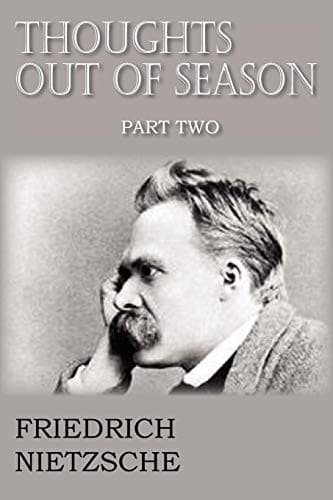
Thoughts Out of Season, Part IINietzsche, Friedrich Wilhelm
PhilosophyPhilosophy
Thoughts Out of Season, Part II
Nietzsche, Friedrich Wilhelm
History -- Study and teaching; Schopenhauer, Arthur, 1788-1860
There were sorrow enough here, if ever, to make such a man envious
and spiteful: but he will turn aside, that he may not destroy his
soul by a vain aspiration; and will discover a new circle of duties.
I can now give an answer to the question whether it be possible to
approach the great ideal of Schopenhauer's man "by any ordinary
activity of our own." In the first place, the new duties are
certainly not those of a hermit; they imply rather a vast community,
held together not by external forms but by a fundamental idea, namely
that of _culture_; though only so far as it can put a single task
before each of us--to bring the philosopher, the artist and the
saint, within and without us, to the light, and to strive thereby for
the completion of Nature. For Nature needs the artist, as she needs
the philosopher, for a metaphysical end, the explanation of herself,
whereby she may have a clear and sharp picture of what she only saw
dimly in the troubled period of transition,--and so may reach
self-consciousness. Goethe, in an arrogant yet profound phrase,
showed how all Nature's attempts only have value in so far as the
artist interprets her stammering words, meets her half-way, and
speaks aloud what she really means. "I have often said, and will
often repeat," he exclaims in one place, "the _causa finalis_ of
natural and human activity is dramatic poetry. Otherwise the stuff is
of no use at all."
Finally, Nature needs the saint. In him the ego has melted away, and
the suffering of his life is, practically, no longer felt as
individual, but as the spring of the deepest sympathy and intimacy
with all living creatures: he sees the wonderful transformation scene
that the comedy of "becoming" never reaches, the attainment, at
length, of the high state of man after which all nature is striving,
that she may be delivered from herself. Without doubt, we all stand
in close relation to him, as well as to the philosopher and the
artist: there are moments, sparks from the clear fire of love, in
whose light we understand the word "I" no longer; there is something
beyond our being that comes, for those moments, to the hither side of
it: and this is why we long in our hearts for a bridge from here to
there. In our ordinary state we can do nothing towards the production
of the new redeemer, and so we hate ourselves in this state with a
hatred that is the root of the pessimism which Schopenhauer had to
teach again to our age, though it is as old as the aspiration after
culture.--Its root, not its flower; the foundation, not the summit;
the beginning of the road, not the end: for we have to learn at some
time to hate something else, more universal than our own personality
with its wretched limitation, its change and its unrest--and this
will be when we shall learn to love something else than we can love
now. When we are ourselves received into that high order of
philosophers, artists and saints, in this life or a reincarnation of
Public-domain text, read in full here on John Shaqi.
Reviews
Reviews
No reviews yet
Be the first to share your thoughts on this work.
Elsewhere in the archive
Join the Discussion
Join the discussion
Sign in to leave a comment or review.
Sign InorCreate an account