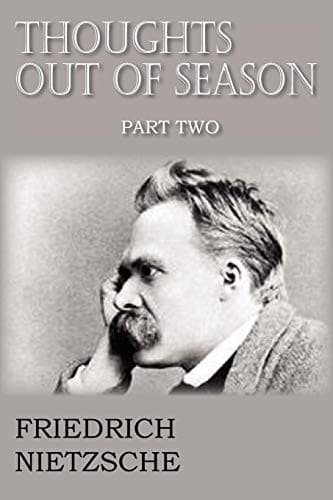
Thoughts Out of Season, Part IINietzsche, Friedrich Wilhelm
PhilosophyPhilosophy
Thoughts Out of Season, Part II
Nietzsche, Friedrich Wilhelm
History -- Study and teaching; Schopenhauer, Arthur, 1788-1860
it, a new object for our love and hate will also rise before us. As
it is, we have our task and our circle of duties, our hates and our
loves. For we know that culture requires us to make ready for the
coming of the Schopenhauer man;--and this is the "use" we are to make
of him;--we must know what obstacles there are and strike them from
our path--in fact, wage unceasing war against everything that
hindered our fulfilment, and prevented us from becoming
Schopenhauer's men ourselves.
VI.
It is sometimes harder to agree to a thing than to understand it;
many will feel this when they consider the proposition--"Mankind must
toil unceasingly to bring forth individual great men: this and
nothing else is its task." One would like to apply to society and its
ends a fact that holds universally in the animal and vegetable world;
where progress depends only on the higher individual types, which are
rarer, yet more persistent, complex and productive. But traditional
notions of what the end of society is, absolutely bar the way. We can
easily understand how in the natural world, where one species passes
at some point into a higher one, the aim of their evolution cannot be
held to lie in the high level attained by the mass, or in the latest
types developed;--but rather in what seem accidental beings produced
here and there by favourable circumstances. It should be just as easy
to understand that it is the duty of mankind to provide the
circumstances favourable to the birth of the new redeemer, simply
because men can have a consciousness of their object. But there is
always something to prevent them. They find their ultimate aim in the
happiness of all, or the greatest number, or in the expansion of a
great commonwealth. A man will very readily decide to sacrifice his
life for the state; he will be much slower to respond if an
individual, and not a state, ask for the sacrifice. It seems to be
out of reason that one man should exist for the sake of another: "Let
it be rather for the sake of every other, or, at any rate, of as many
as possible!" O upright judge! As if it were more in reason to let
the majority decide a question of value and significance! For the
problem is--"In what way may your life, the individual life, retain
the highest value and the deepest significance? and how may it least
be squandered?" Only by your living for the good of the rarest and
most valuable types, not for that of the majority,--who are the most
worthless types, taken as individuals. This way of thinking should be
implanted and fostered in every young man's mind: he should regard
himself both as a failure of Nature's handiwork and a testimony to
her larger ideas. "She has succeeded badly," he should say; "but I
will do honour to her great idea by being a means to its better
success."
Public-domain text, read in full here on John Shaqi.
Reviews
Reviews
No reviews yet
Be the first to share your thoughts on this work.
Elsewhere in the archive
Join the Discussion
Join the discussion
Sign in to leave a comment or review.
Sign InorCreate an account