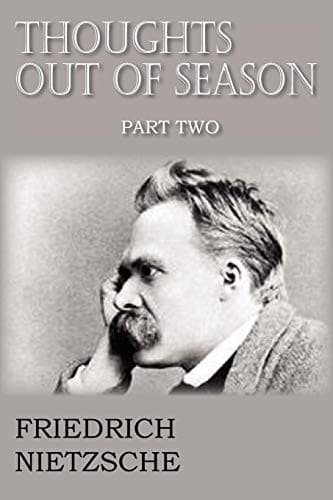
Thoughts Out of Season, Part IINietzsche, Friedrich Wilhelm
PhilosophyPhilosophy
Thoughts Out of Season, Part II
Nietzsche, Friedrich Wilhelm
History -- Study and teaching; Schopenhauer, Arthur, 1788-1860
Any one who can reach the second step, will see how extremely rare
and imperceptible the knowledge of that end is, though all men busy
themselves with culture and expend vast labour in her service. He
asks himself in amazement--"Is not such knowledge, after all,
absolutely necessary? Can Nature be said to attain her end, if men
have a false idea of the aim of their own labour?" And any one who
thinks a great deal of Nature's unconscious adaptation of means to
ends, will probably answer at once: "Yes, men may think and speak
what they like about their ultimate end, their blind instinct will
tell them the right road." It requires some experience of life to be
able to contradict this: but let a man be convinced of the real aim
of culture--the production of the true man and nothing else;--let him
consider that amid all the pageantry and ostentation of culture at
the present time the conditions for his production are nothing but a
continual "battle of the beasts": and he will see that there is great
need for a conscious will to take the place of that blind instinct.
There is another reason also;--to prevent the possibility of turning
this obscure impulse to quite different ends, in a direction where
our highest aim can no longer be attained. For we must beware of a
certain kind of misapplied and parasitical culture; the powers at
present most active in its propagation have other casts of thought
that prevent their relation to culture from being pure and
disinterested.
The first of these is the self-interest of the business men. This
needs the help of culture, and helps her in return, though at the
price of prescribing her ends and limits. And their favourite sorites
is: "We must have as much knowledge and education as possible; this
implies as great a need as possible for it, this again as much
production, this again as much material wealth and happiness as
possible."--This is the seductive formula. Its preachers would define
education as the insight that makes man through and through a "child
of his age" in his desires and their satisfaction, and gives him
command over the best means of making money. Its aim would be to make
"current" men, in the same sense as one speaks of the "currency" in
money; and in their view, the more "current" men there are, the
happier the people. The object of modern educational systems is
therefore to make each man as "current" as his nature will allow him,
and to give him the opportunity for the greatest amount of success
and happiness that can be got from his particular stock of knowledge.
He is required to have just so much idea of his own value (through
his liberal education) as to know what he can ask of life; and he is
assured that a natural and necessary connection between "intelligence
and property" not only exists, but is also a _moral_ necessity. All
education is detested that makes for loneliness, and has an aim above
money-making, and requires a long time: men look askance on such
Public-domain text, read in full here on John Shaqi.
Reviews
Reviews
No reviews yet
Be the first to share your thoughts on this work.
Elsewhere in the archive
Join the Discussion
Join the discussion
Sign in to leave a comment or review.
Sign InorCreate an account