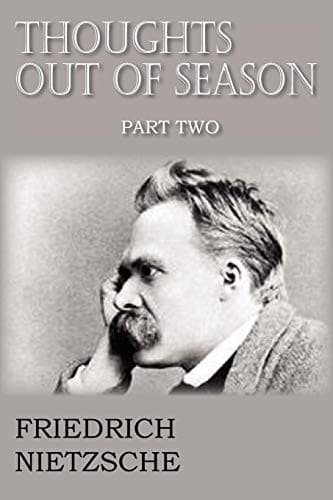
Thoughts Out of Season, Part IINietzsche, Friedrich Wilhelm
PhilosophyPhilosophy
Thoughts Out of Season, Part II
Nietzsche, Friedrich Wilhelm
History -- Study and teaching; Schopenhauer, Arthur, 1788-1860
With these thoughts he will enter the circle of culture, which is the
child of every man's self-knowledge and dissatisfaction. He will
approach and say aloud: "I see something above me, higher and more
human than I: let all help me to reach it, as I will help all who
know and suffer as I do, that the man may arise at last who feels his
knowledge and love, vision and power, to be complete and boundless,
who in his universality is one with nature, the critic and judge of
existence." It is difficult to give any one this courageous
self-consciousness, because it is impossible to teach love; from love
alone the soul gains, not only the clear vision that leads to
self-contempt, but also the desire to look to a higher self which is
yet hidden, and strive upward to it with all its strength. And so he
who rests his hope on a future great man, receives his first
"initiation into culture." The sign of this is shame or vexation at
one's self, a hatred of one's own narrowness, a sympathy with the
genius that ever raises its head again from our misty wastes, a
feeling for all that is struggling into life, the conviction that
Nature must be helped in her hour of need to press forward to the
man, however ill she seem to prosper, whatever success may attend her
marvellous forms and projects: so that the men with whom we live are
like the débris of some precious sculptures, which cry out--"Come and
help us! Put us together, for we long to become complete."
I called this inward condition the "first initiation into culture." I
have now to describe the effects of the "second initiation," a task
of greater difficulty. It is the passage from the inner life to the
criticism of the outer life. The eye must be turned to find in the
great world of movement the desire for culture that is known from the
immediate experience of the individual; who must use his own
strivings and aspirations as the alphabet to interpret those of
humanity. He cannot rest here either, but must go higher. Culture
demands from him not only that inner experience, not only the
criticism of the outer world surrounding him, but action too to crown
them all, the fight for culture against the influences and
conventions and institutions where he cannot find his own aim,--the
production of genius.
Public-domain text, read in full here on John Shaqi.
Reviews
Reviews
No reviews yet
Be the first to share your thoughts on this work.
Elsewhere in the archive
Join the Discussion
Join the discussion
Sign in to leave a comment or review.
Sign InorCreate an account