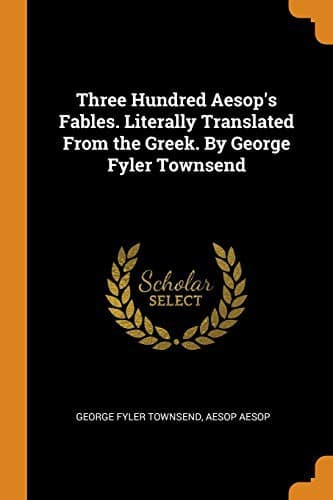
Three hundred Aesop’s fables: Translated by George Fyler TownsendAesop
General
Three hundred Aesop’s fables: Translated by George Fyler Townsend
Aesop
Aesop's fables -- Translations into English; Fables, Greek -- Translations into English
ACCORDING to an ancient legend, the first man was made by Jupiter, the
first bull by Neptune, and the first house by Minerva. On the
completion of their labours, a dispute arose as to which had made the
most perfect work. They agreed to appoint Momus as judge, and to abide
by his decision. Momus, however, being very envious of the handicraft
of each, found fault with all. He first blamed the work of Neptune
because he had not made the horns of the bull below his eyes, so he
might better see where to strike. He then condemned the work of
Jupiter, because he had not placed the heart of man on the outside,
that everyone might read the thoughts of the evil disposed and take
precautions against the intended mischief. And, lastly, he inveighed
against Minerva because she had not contrived iron wheels in the
foundation of her house, so its inhabitants might more easily remove if
a neighbor proved unpleasant. Jupiter, indignant at such inveterate
faultfinding, drove him from his office of judge, and expelled him from
the mansions of Olympus.
The Eagle and the Jackdaw
AN EAGLE, flying down from his perch on a lofty rock, seized upon a
lamb and carried him aloft in his talons. A Jackdaw, who witnessed the
capture of the lamb, was stirred with envy and determined to emulate
the strength and flight of the Eagle. He flew around with a great whir
of his wings and settled upon a large ram, with the intention of
carrying him off, but his claws became entangled in the ram’s fleece
and he was not able to release himself, although he fluttered with his
feathers as much as he could. The shepherd, seeing what had happened,
ran up and caught him. He at once clipped the Jackdaw’s wings, and
taking him home at night, gave him to his children. On their saying,
“Father, what kind of bird is it?” he replied, “To my certain knowledge
he is a Daw; but he would like you to think an Eagle.”
The Eagle and the Fox
AN EAGLE and a Fox formed an intimate friendship and decided to live
near each other. The Eagle built her nest in the branches of a tall
tree, while the Fox crept into the underwood and there produced her
young. Not long after they had agreed upon this plan, the Eagle, being
in want of provision for her young ones, swooped down while the Fox was
out, seized upon one of the little cubs, and feasted herself and her
brood. The Fox on her return, discovered what had happened, but was
less grieved for the death of her young than for her inability to
avenge them. A just retribution, however, quickly fell upon the Eagle.
While hovering near an altar, on which some villagers were sacrificing
a goat, she suddenly seized a piece of the flesh, and carried it, along
with a burning cinder, to her nest. A strong breeze soon fanned the
spark into a flame, and the eaglets, as yet unfledged and helpless,
were roasted in their nest and dropped down dead at the bottom of the
tree. There, in the sight of the Eagle, the Fox gobbled them up.
The Two Bags
Public-domain text, read in full here on John Shaqi.
Reviews
Reviews
No reviews yet
Be the first to share your thoughts on this work.
Elsewhere in the archive
Join the Discussion
Join the discussion
Sign in to leave a comment or review.
Sign InorCreate an account