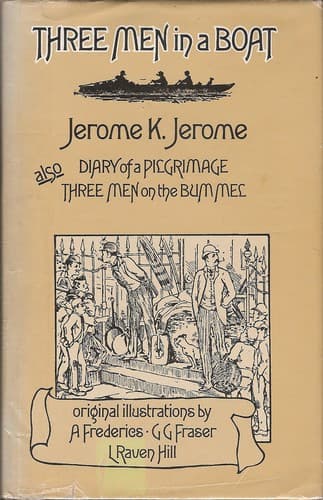
Three men on the bummelJerome, Jerome K. (Jerome Klapka)
General
Three men on the bummel
Jerome, Jerome K. (Jerome Klapka)
Bicycle touring -- Fiction; Black Forest (Germany) -- Fiction; British -- Germany -- Fiction; Humorous stories
"I may have been critical," admitted George "but look at the thing from
my point of view. One of you says he's got an instinct, and leads me to
a wasps' nest in the middle of a wood."
"I can't help wasps building in a wood," I replied.
"I don't say you can," answered George. "I am not arguing; I am merely
stating incontrovertible facts. The other one, who leads me up and down
hill for hours on scientific principles, doesn't know the north from the
south, and is never quite sure whether he's turned round or whether he
hasn't. Personally, I profess to no instincts beyond the ordinary, nor
am I a scientist. But two fields off I can see a man. I am going to
offer him the worth of the hay he is cutting, which I estimate at one
mark fifty pfennig, to leave his work, and lead me to within sight of
Todtmoos. If you two fellows like to follow, you can. If not, you can
start another system and work it out by yourselves."
George's plan lacked both originality and aplomb, but at the moment it
appealed to us. Fortunately, we had worked round to a very short
distance away from the spot where we had originally gone wrong; with the
result that, aided by the gentleman of the scythe, we recovered the road,
and reached Todtmoos four hours later than we had calculated to reach it,
with an appetite that took forty-five minutes' steady work in silence to
abate.
From Todtmoos we had intended to walk down to the Rhine; but having
regard to our extra exertions of the morning, we decided to promenade in
a carriage, as the French would say: and for this purpose hired a
picturesque-looking vehicle, drawn by a horse that I should have called
barrel-bodied but for contrast with his driver, in comparison with whom
he was angular. In Germany every vehicle is arranged for a pair of
horses, but drawn generally by one. This gives to the equipage a lop-
sided appearance, according to our notions, but it is held here to
indicate style. The idea to be conveyed is that you usually drive a pair
of horses, but that for the moment you have mislaid the other one. The
German driver is not what we should call a first-class whip. He is at
his best when he is asleep. Then, at all events, he is harmless; and the
horse being, generally speaking, intelligent and experienced, progress
under these conditions is comparatively safe. If in Germany they could
only train the horse to collect the money at the end of the journey,
there would be no need for a coachman at all. This would be a distinct
relief to the passenger, for when the German coachman is awake and not
cracking his whip he is generally occupied in getting himself into
trouble or out of it. He is better at the former. Once I recollect
driving down a steep Black Forest hill with a couple of ladies. It was
one of those roads winding corkscrew-wise down the slope. The hill rose
at an angle of seventy-five on the off-side, and fell away at an angle of
seventy-five on the near-side. We were proceeding very comfortably, the
Public-domain text, read in full here on John Shaqi.
Reviews
Reviews
No reviews yet
Be the first to share your thoughts on this work.
Elsewhere in the archive
Join the Discussion
Join the discussion
Sign in to leave a comment or review.
Sign InorCreate an account