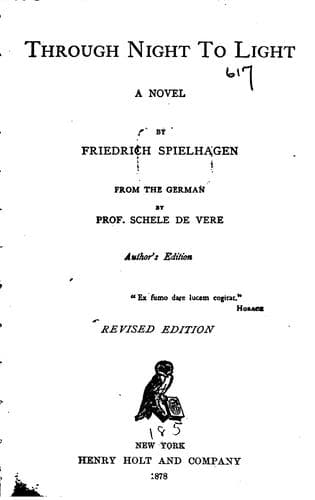
Through Night to Light: A NovelSpielhagen, Friedrich
General
Through Night to Light: A Novel
Spielhagen, Friedrich
Fiction
The haste with which Franz pressed her had a very good motive
in the illness of her father. Franz, as a physician, knew best that
the life of the excellent man was hanging on a very slender thread. He
had rallied quickly enough from a stroke of apoplexy, which had
attacked him a fortnight ago, but several bad symptoms announced that
another attack was not improbable, and with his nervous, very
delicately-organized system, this was likely to be fatal. But if the
father died before his daughter had been married, the poor girl would
have been placed in a very painful position, as her mother had been
dead for many years, and she had neither brothers and sisters nor any
near relations. The world with its prejudices would have hardly been
willing to admit that under such circumstances her only home should be
in the house of the man whom she loved, but would have been
inconceivably shocked if the daughter had married "before the shoes
were worn out in which she had followed her father's funeral." The
whole city would have broken out in one cry of indignation against such
a fearful crime against decency and propriety.
Sophie loved her father with a love which bordered upon enthusiasm,
little as enthusiasm generally formed a part of her clear and sensible
character, which shrank instinctively from all exaggeration. And the
father was well worthy of such love.
The privy councillor, Roban, was a man of rare distinction in many
respects. As a man of science he stood very high; he was considered the
very first pathologist in Germany. But a remarkable versatility of mind
enabled him to gather, outside of the studies which his profession
required, information upon the most varied fields of knowledge, and to
attain to a high degree of perfection in more than one of the arts. In
the morning he would take his pupils, hour after hour, from bed to bed
in the hospital, and open to them views into the innermost workings of
nature. Then again he would wander for long hours from house to house,
soothing here a sufferer's pains, comforting others, and exhorting them
to patient endurance. And yet in the evening, when a circle of intimate
friends were gathered under his hospitable roof, he would be ready to
take an active part in an animated conversation about art, literature,
or politics, or perhaps take his favorite instrument, the violoncello,
between his knees, and delight even the best cultivated ears by his
correct and yet deeply-felt playing in a quickly-improvised quartette.
Public-domain text, read in full here on John Shaqi.
Reviews
Reviews
No reviews yet
Be the first to share your thoughts on this work.
Elsewhere in the archive
Join the Discussion
Join the discussion
Sign in to leave a comment or review.
Sign InorCreate an account