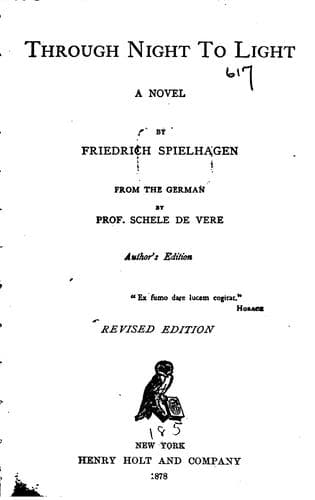
Through Night to Light: A NovelSpielhagen, Friedrich
General
Through Night to Light: A Novel
Spielhagen, Friedrich
Fiction
"I do not see," he said, "where this is to end. If the king does not
wish--and I believe he really does not wish--that a sheet of paper,
which they call a constitution, should rise between him and the people,
according to which he is forced to govern, whether he will or not, then
he ought not to have conjured up even the shadow of a constitution. The
shadow is soon followed by the substance. I confess that I am disgusted
by the patience of the king, while these fellows cry so loud; and that
I have long doubted whether I could honorably serve a monarch who thus
misjudges the duty of a king 'by the grace of God.'"
When the prince was thus judging things by the standard of his Russian
ideas of absolute government, it sometimes happened that there arose in
Helen's naturally good and affectionate heart a repugnance, not unmixed
with terror, towards one who could utter such inhuman thoughts in cold
blood. At other times she would have shrunk from the fearful
consequences of such principles, but now she was too deeply irritated
by the wound which Oswald's treachery had inflicted on her proud heart,
and, as is the case with violent dispositions, she had hastened from
one extreme to the other. Helen hated Oswald. She wept tears of
indignation and of shame when she thought how dear this man had been to
her, and how near she had been to the danger of showing him her love
for him. The treachery itself was no longer doubtful to her mind.
Emily's manner had changed so strikingly of late that even outsiders
had noticed it. The young lady who had formerly found happiness only in
the wildest turmoil of pleasure, now avoided society as much as she had
formerly sought it; and when she could not escape from invitations to
her former circles, she seemed to have only scoffing and scorn for all
she had admired in other days. She declared that the officers were
stupid, dancing a childish amusement, and a masked ball the height of
absurdity. She treated the ladies with undisguised irony, and the men
with open contempt, especially her husband, who did not know what to
make of the strange change, and only discovered gradually the one fact,
that of all the many foolish things which Albert Cloten had done in his
time, the making of an accomplished coquette, like the "divine Emily
Breesen," his wife, was beyond all doubt the most foolish. Most people
laughed, and said: "It is a whim of the little woman's; she will soon
come right again." Others, who were less harmless, said: "There is
something behind that! When a young woman treats the whole world, not
excluding her husband, _en canaille_, she does so only for the sake of
a man who is himself her whole world." But they racked their brains in
vain to find out who the lucky man could be. Some guessed it was young
Count Grieben, who had formerly courted her; others, Baron Sylow; still
others, even Prince Waldenberg; and only Helen Grenwitz knew that they
were all mistaken, and that the object of Emily's love was not to be
Public-domain text, read in full here on John Shaqi.
Reviews
Reviews
No reviews yet
Be the first to share your thoughts on this work.
Elsewhere in the archive
Join the Discussion
Join the discussion
Sign in to leave a comment or review.
Sign InorCreate an account