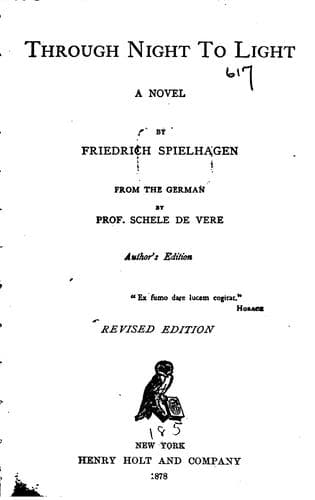
Through Night to Light: A NovelSpielhagen, Friedrich
General
Through Night to Light: A Novel
Spielhagen, Friedrich
Fiction
It was an early hour of a murky day in autumn. Fogs were brewing in the
mountains around Fichtenau, and hung so low that the traveller on the
high road, which makes a steep ascent close behind the village and
loses itself in thick woods, could scarcely distinguish the pine-trees
on the edge of the forest.
By the wayside, at a place where two roads crossed each other, sat
Xenobia and Czika. Their faithful companion in all their wanderings,
the little donkey, with the red feathers on his head and the scarlet
saddle-cloth on his back, was grazing peacefully in the ditch on the
short, ill-flavored grass. He did not seem to relish it much; he shook
his head indignantly, as if he wanted to say: I am frugal, but
everything has its limits.
Nor did the gypsy woman and her child seem to enjoy the weather any
more. They sat there, each wrapped in a large coarse shawl, silent and
motionless, like a couple of Egyptian statues. This attitude, natural
as it might be to the woman, had something very uncanny in so young a
child as Czika.
And Xenobia herself was no longer the hearty woman whom Oswald had seen
on that afternoon in October in the forest near Berkow. Was it the
effect of the weather, or was it sickness and sorrow--but her features
had little now of that haughty energy which formerly made them so
remarkable. Her brow was furrowed with small lines; her eyes had sunk
deep into their orbits and did not shine with the same brightness as of
old, as she now glanced in the direction from which her sharp ear heard
the noise of a carriage comings from Fichtenau.
"That is not theirs," she said, letting her head sink again. A few
minutes later a well-closed travelling carriage, drawn by two horses,
appeared rising out of the fog. On the box, by the side of the driver,
sat an old man with a long, silver-gray moustache. He turned round
continually, to cast a look at the inside of the carriage, and to smile
respectfully and yet amicably at the occupants--a lady and a boy.
Thus he had failed to notice the gypsy woman, who had stepped forward
as she saw the great lady in the carriage, and asked for alms. What was
his amazement therefore, when he saw that the lady suddenly called to
him to stop the horses, exhibiting all the signs of extreme
consternation, and that she was standing in the road itself long before
the horses could be checked.
"Isabel, it is you! and the Czika! My God, how fortunate!" cried
Melitta, seizing both hands of the gypsy. "Now I shall not let you go
again. My God, how very fortunate!" and the young lady embraced the
gypsy woman with tears in her eyes.
But the latter freed herself almost violently, and stepping back some
little distance she crossed her arms on her bosom and looked at Melitta
with a suspicious, almost hostile glance.
"Do you not know me, Isabel?" said Melitta; "it is I! Have you
forgotten the days at Berkow five years ago? That is my Julius, there!
And how tall and how beautiful the Czika has grown."
Public-domain text, read in full here on John Shaqi.
Reviews
Reviews
No reviews yet
Be the first to share your thoughts on this work.
Elsewhere in the archive
Join the Discussion
Join the discussion
Sign in to leave a comment or review.
Sign InorCreate an account