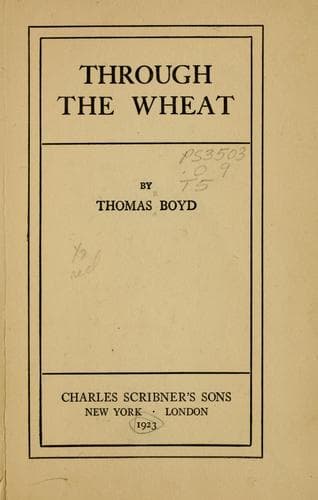
United States. Marine Corps -- Fiction; War stories; World War, 1914-1918 -- Fiction
They talked on in undertones, while Hicks, silent, smiled serenely in
the darkness. Suddenly he realized that they were not the only persons
in the trench. A few feet before him two other bodies, huddled together,
were discernible. He had no thought of the fact that he was between both
lines, and that any other persons who were also there must be enemies. He
only knew that he wanted to talk to these strangers in front of him.
“It’s a quiet night, what?”
“Don’t talk so loud,” the men beside him counselled.
He shook his head, annoyed at their interruption, and began again:
“What outfit do you fellows belong to?”
“Who are you talkin’ to, Hicks? What’s the matter with you?” his loader
impatiently asked.
Hicks ignored him. “What outfit did you say you belonged to? What?”—as if
they had answered indistinctly.
He rose and stood in front of them.
“I asked you a civil question. Why can’t you answer me?”
Their silence infuriated him.
“Answer me, damn it.” He grasped the shoulders of one of the bodies,
shaking them. Beneath the clothing the flesh loosened from the body.
“Hell, you’re dead,” Hicks told the body disgustedly. He turned to his
gun crew. “They’re dead. That’s why they didn’t answer me. No damned
good.”
The loader turned to the other man.
“Le’s git outa here, Hicks is nuts.”
“Yeah. He gives me the creeps.”
They climbed out of the trench and scurried back to their places among
the platoon.
Hicks sat down across from the two bodies. His elbows on his knees, his
arms folded, he lowered his head and was soon asleep. He was awakened by
voices crying:
“Hicks! What’s wrong?”
“What are you doing out here?”
“Tryin’ to git a cru de geer by stayin’ out alone all night?”
He looked up and through the early dawn saw the faces of his own platoon.
Without answering he picked up his automatic rifle which lay beside him,
and joined them.
* * * * *
The ground over which they were advancing was flat for a long distance,
then it rose in a steep hill that stood majestically in the dawn. Upon
the ground many people had left their marks: a group of bones, a piece of
equipment, a helmet, a rifle barrel from which the stock had rotted.
There was no hindrance to the advance of the platoon. From that point
in the line which for miles was being attacked that morning, even the
rear-guard had withdrawn. But the withdrawal had been made to the top
of the hill, whose crest was a large plateau. Perhaps a thousand yards
from the brink, where a ridge cut the flatness of the ground, the German
lines had intrenched and lay waiting to be attacked.
As the platoon climbed up the hill they could hear the friendly explosion
of their own barrage. It gave them strength to thread their way among the
bushes on the hill, ever nearing the summit, and not knowing the sort of
reception that was waiting for them.
Public-domain text, read in full here on John Shaqi.
Reviews
Reviews
No reviews yet
Be the first to share your thoughts on this work.
Elsewhere in the archive
Join the Discussion
Join the discussion
Sign in to leave a comment or review.
Sign InorCreate an account