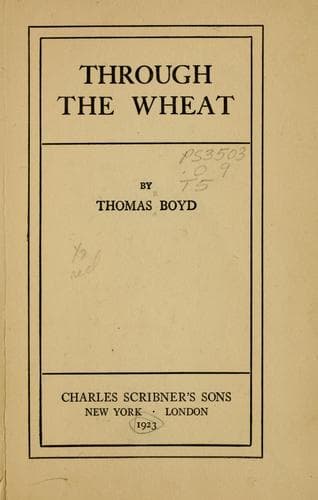
United States. Marine Corps -- Fiction; War stories; World War, 1914-1918 -- Fiction
A portly captain, puffing like a porpoise, clambered up with them. From
time to time he would stop and take from his hip pocket a brightly
colored paper sack of scrap tobacco. Then, with a generous amount in the
side of his mouth, he would begin again the ascent. He offered the paper
bag to some of the men nearer to him, and they accepted it gratefully,
but not cramming their mouths so full as he. The portly captain also
invented the fiction that he was a former brewery-wagon driver in St.
Louis and that, “By God, he wished he was back on a brewery wagon again.”
The men laughed obligingly but hollowly.
The platoon reached the summit. Little curls of gray smoke, looking like
shadowy question-marks, rose over the plateau in the distance. Beyond
was the ridge, perhaps a mile from the brink over which the men were
climbing. To the right of the ridge a long, white-sided, red-topped
farmhouse rested. To the left the plateau ended in another hill.
It was not long after the platoon had arrived on the level ground that
machine-guns began pouring a steady stream of lead over the field.
Hesitatingly the platoon advanced. The machine-guns were pointing too
high. Occasionally a bullet, probably a faulty one, struck the ground
beside the slowly advancing line, but without force.
The portly captain shifted his wad of tobacco, spat a thin stream, and
ordered the platoon to halt.
“How many of you men have got shovels?”
There were half a dozen shovels and two picks.
“All right, you men with shovels. Halt right here and dig a trench as
long and as deep as you can. The rest of us—Forward!”
Slowly, warily, they set forth again. Now no one spoke, not even the
garrulous and confidence-breeding captain.
The machine-guns aimed lower, but too low. Only the ricochetting bullets
reached the platoon.
They advanced until they were half-way to the ridge. Then they discovered
that there were Germans much nearer to them than they had supposed. From
little humps on the ground rifle bullets pinged past, shaving near the
ears of the men. From the hill on the left came a whining serenade of
lead. Shots were being fired from every direction but from the rear. The
men threw themselves upon the ground, not knowing what to do.
After a long wait the firing abated and the platoon started to creep
forward. Instantly their movement was met with a hail of bullets. They
lay quite still, their uniforms blending with the russet of the grass, on
which the sun shone with intense vigor.
Hicks, lying at the extreme left of the platoon, was engaged in
corralling those words which entered his mind and placing them into two
classes—words with an even number of letters, words with an uneven number
of letters. He had long held the view that the evenly lettered words were
preponderant.
Public-domain text, read in full here on John Shaqi.
Reviews
Reviews
No reviews yet
Be the first to share your thoughts on this work.
Elsewhere in the archive
Join the Discussion
Join the discussion
Sign in to leave a comment or review.
Sign InorCreate an account