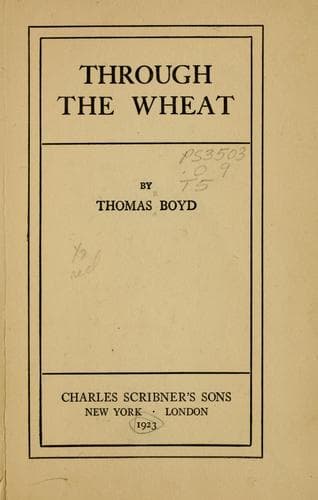
United States. Marine Corps -- Fiction; War stories; World War, 1914-1918 -- Fiction
Their cowardice made them brave men, heroes. Pushing on, they swung to
the right toward the town. Through the open field they ran in little
spurts, falling on their faces, rising and rushing on. From the windows
of the houses and beside the walls bullets zinged past, stopping men and
sending them headlong upon the ground. A small number of them rushed into
the town.
Bullets flew in every direction. Men toppled down from the windows of
houses. Others raced up the steps of the dwellings. Men ran through the
streets, wild and tumultuous. They returned to the pavement, guarding
their captives. Men poured the hate of their beings upon the town. They
wept and cursed like lost souls in limbo. All of their fear, all of their
anxiety, all of the restraint which had been forced on them during the
morning when they lay like animals in a slaughter-house and their brains
numbed with apprehension, came out in an ugly fury.
Once the Germans found that the town was invaded, that the men had
broken through the woods and barbed wire, they offered a weak and empty
resistance. They would readily have given themselves up to be marched in
an orderly procession back to a prison camp. There was only a section
holding the town. But the men did not know this. All of the stories of
German frightfulness, of German courage, of the ruthlessness of the
German foot troops, made them battle on in fear.
At last two squads of worn, frightened Germans were assembled in the town
square and, threats following after them, were marched back to the rear.
It was pitiful to see the Germans reaching in their breast pockets and
bringing forth cigars which they cherished, and offering them to their
captors as an act of amelioration. Some had bars of chocolate which they
readily gave and which the men readily accepted. Some of the Germans
tried even to smile, their efforts proving pathetic because of their fear.
The afternoon sun threw wan rays on the distorted bodies which fear and
surprise had drawn out of shape. As had been the case with life, death
had not fashioned their features identically. Some wore expressions of
peace, as if they were about to enjoy a long and much-needed rest; others
sprawled with sagging chins, from which a stream of saliva had flown;
one face grinned like an idiot’s. The shadows lengthened, blanketing the
unresisting bodies. The men marched out of the town, leaving it to the
dead and the night.
Public-domain text, read in full here on John Shaqi.
Reviews
Reviews
No reviews yet
Be the first to share your thoughts on this work.
Elsewhere in the archive
Join the Discussion
Join the discussion
Sign in to leave a comment or review.
Sign InorCreate an account