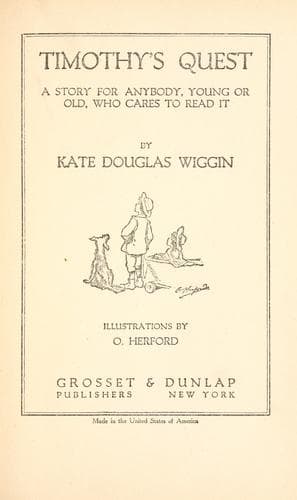
Timothy's Quest: A Story for Anybody, Young or Old, Who Cares to Read ItWiggin, Kate Douglas Smith
General
Timothy's Quest: A Story for Anybody, Young or Old, Who Cares to Read It
Wiggin, Kate Douglas Smith
Orphans -- Juvenile fiction
It was called the White Farm, not because that was an unusual color in
Pleasant River. Nineteen out of every twenty houses in the village were
painted white, for it had not then entered the casual mind that any
other course was desirable or possible. Occasionally, a man of riotous
imagination would substitute two shades of buff, or make the back of his
barn red, but the spirit of invention stopped there, and the majority of
sane people went on painting white. But Miss Avilda Cummins was blessed
with a larger income than most of the inhabitants of Pleasant River, and
all her buildings, the great house, the sheds, the carriage and dairy
houses, the fences and the barn, were always kept in a state of dazzling
purity; "as if," the neighbors declared, "S'manthy Ann Ripley went over
'em every morning with a dust-cloth."
It was merely an accident that the carriage and work horses chanced to
be white, and that the original white cats of the family kept on having
white kittens to decorate the front doorsteps. It was not accident,
however, but design, that caused Jabe Slocum to scour the country for a
good white cow and persuade Miss Cummins to swap off the old red one, so
that the "critters" in the barn should match.
Miss Avilda had been born at the White Farm; father and mother had been
taken from there to the old country churchyard, and "Martha, aged 17,"
poor, pretty, willful Martha, the greatest pride and greatest sorrow of
the family, was lying under the apple trees in the garden.
Here also the little Samantha Ann Ripley had come as a child years ago,
to be playmate, nurse, and companion to Martha, and here she had stayed
ever since, as friend, adviser, and "company-keeper" to the lonely Miss
Cummins. Nobody in Pleasant River would have dared to think of her as
anybody's "hired help," though she did receive bed and board, and a
certain sum yearly for her services; but she lived with Miss Cummins on
equal terms, as was the custom in the good old New England villages,
doing the lion's share of the work, and marking her sense of the
situation by washing the dishes while Miss Avilda wiped them, and by
never suffering her to feed the pig or go down cellar.
Public-domain text, read in full here on John Shaqi.
Reviews
Reviews
No reviews yet
Be the first to share your thoughts on this work.
Join the Discussion
Join the discussion
Sign in to leave a comment or review.
Sign InorCreate an account