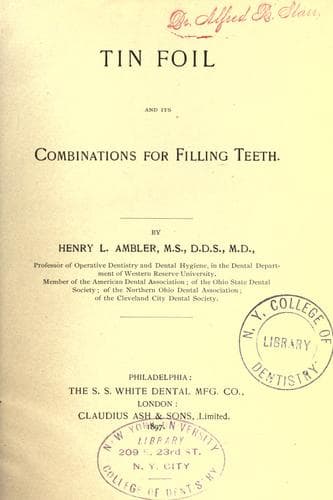
Tin Foil and Its Combinations for Filling Teeth — John Shaqi
Tin Foil and Its Combinations for Filling TeethAmbler, Henry Lovejoy
Science
Tin Foil and Its Combinations for Filling Teeth
Ambler, Henry Lovejoy
Dentistry
"Among the best operators a more general use of tin would produce
advantageous results, while among those whose operations in gold are not
generally successful an almost exclusive use of tin would bring about a
corresponding quantum of success to themselves and patients, as against
repeated failures with gold. The same degree of endeavor which lacked
success with gold, if applied to tin would produce good results and save
teeth. A golden shower of ducats realized for gold finds enthusiastic
admirers, but a dull gray shower for tin work is not so admirable, even
though many of the teeth were no better for the gold as gold, nor so
well off in the ultimate as with tin." (Dr. E. W. Foster, _Dental
Cosmos_, 1873.)
In 1873 Dr. Royal Varney said, "I am heartily in favor of tin; it is too
much neglected by our first-class operators."
"Tin stops the ends of the tubuli and interglobular spaces which are
formed in the teeth of excessive vascular organization; if more teeth
were filled with tin, and a smaller number with futile attempts with
gold, people would be more benefited." (Dr. Castle, _Dental Cosmos_,
1873.)
"If cavities in teeth out of the mouth are well filled with tin, and put
into ink for three days, no discoloration of the tooth (when split open)
can be seen." (W. E. Driscoll, _Dental Cosmos_, 1874.)
"Tin makes an hermetical filling, and resists the disintegrating action
of the fluids of the mouth. If an operator can preserve teeth for
fifteen dollars with tin, which would cost fifty dollars with gold,
ought he not to do so? Upon examination of the cavities from which
oxidized plugs have been removed, these oxids will be found to have had
a reflex effect upon the dentin; the walls and floors will be discolored
and thoroughly indurated, and to a great degree devoid of sensitiveness,
although they were sensitive when filled. Tin is valuable in case of
youth, nervousness, impatience, high vitality of dentin, low
calcification, and low pecuniosity." (Dr. H. Gerhart, _Pennsylvania
Journal of Dental Science_, 1875.)
"Tin Foil for Filling Teeth." Essay by Dr. H. L. Ambler, read before the
Ohio State Dental Society. (_Dental Register of the West_, 1875.)
"Some say that if tin is the material the cavity must be filled with,
that it must be filled entirely with it, but advanced teachings show
differently." (Dr. D. D. Smith, _Dental Cosmos_, October, 1878.)
"Frail teeth can be saved better with tin than with gold. I never saw a
devitalized pulp under a tin filling." (Dr. Dixon, _Dental Cosmos_, May,
1880.)
"Tin may be used as a base for proximate fillings in bicuspids or
molars, in third molars, in children's permanent molars, in the
temporary teeth, and in any cavity where the filling is not
conspicuous." (Dr. A. W. Harlan, _Independent Practitioner_, 1884.)
Public-domain text, read in full here on John Shaqi.
Reviews
Reviews
No reviews yet
Be the first to share your thoughts on this work.
Join the Discussion
Join the discussion
Sign in to leave a comment or review.
Sign InorCreate an account