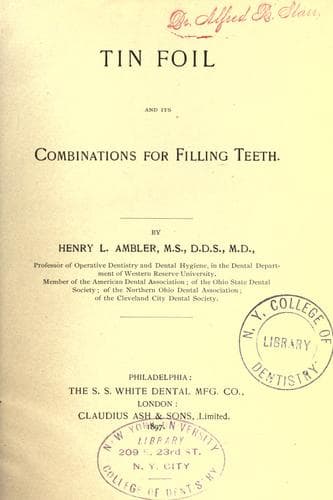
Tin Foil and Its Combinations for Filling TeethAmbler, Henry Lovejoy
Science
Tin Foil and Its Combinations for Filling Teeth
Ambler, Henry Lovejoy
Dentistry
On the same plan, proximal cavities in the anterior teeth can be filled,
and also buccal cavities in molars, especially where they extend to the
occlusal surface. The cervical margin should be well covered with tin
thoroughly condensed, thus securing perfect adaptation, and a solid base
for the gold with which the filling is to be completed. Time has fully
demonstrated that the cervical margin is most liable to caries, and here
the conservative and preservative qualities of tin make it specially
applicable.
"Electrolysis demonstrates to us that no single metal can be decomposed,
but when gold and tin are used in the above manner they are united at
the line of contact by electrolysis. The surface of both metals is
exposed to the fluids of the mouth, and the oxid of tin is deposited on
the tin, by reason of the current set up by the gold; thus some atoms of
tin are dissolved and firmly attached to the gold, but the tin does not
penetrate the gold to any great extent." (Dr. S. B. Palmer.)
This connection of the metals assists in holding the filling in place,
but it is more likely to break apart than if it was all gold. After
electrolysis has taken place at the junction, it requires a cutting
instrument to completely separate the tin and gold.
For filling by hand pressure, use instruments with square ends and
sides, medium serrations, and of any form or size which will best reach
the cavity.
For filling with the hand mallet, use instruments with medium
serrations, and a steady medium blow with a four-ounce mallet; in force
of blow we are guided by thickness of tin, size of plugger, and depth of
serrations, strength of cavity-walls and margins, the same as in using
gold. The majority of medium serrated hand mallet pluggers will work
well on No. 10 tin of one, two, or three thicknesses. If the tin shows
any tendency to slide, use a more deeply serrated plugger. The
electro-magnetic, and mechanical (engine) mallet do not seem to work tin
as well as the hand mallet or hand force, as the tendency of such
numerous and rapid blows is to chop up the tin and prevent the making of
a solid mass, and also injure the receiving surface of the filling. In
using any kind of force, _always_ aim to carry the material to place
before delivering the pressure, or blow.
Public-domain text, read in full here on John Shaqi.
Reviews
Reviews
No reviews yet
Be the first to share your thoughts on this work.
Join the Discussion
Join the discussion
Sign in to leave a comment or review.
Sign InorCreate an account