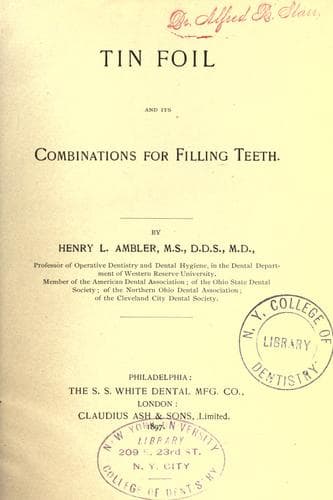
Tin Foil and Its Combinations for Filling TeethAmbler, Henry Lovejoy
Science
Tin Foil and Its Combinations for Filling Teeth
Ambler, Henry Lovejoy
Dentistry
If a pulp ever does die under tin, perhaps it will not decompose as
rapidly as it otherwise would, owing to its being charged with
tin-salts.
The Herbst method of filling consists in introducing and condensing tin
in cavities by means of smooth, highly tempered steel engine or hand
burnishers. In the engine set of instruments there is one oval end
inverted cone-shaped, one pear-shaped, and one bud-shaped. The revolving
burnisher is held firmly against the tin, a few seconds in a place, and
moved around, especially along the margins, not running the engine too
fast. Complicated cavities are converted into simple ones by using a
matrix, and proximal cavities in bicuspids and molars are entered from
the occlusal surface. The tin foil is cut into strips, and then made
into ropes, which are cut into pieces of different lengths; the first
piece must be large enough so that when it is condensed it will lie
firmly in the cavity without being held; thus a piece at a time is added
until the cavity is full. The hand set of burnishers has four which are
pear-shaped and vary in size, and one which is rather small and
roof-shaped. In filling and condensing they are rotated in the hand
one-half or three-quarters of a turn.
Dr. Herbst claims a better adaptation to the walls of the cavity than by
any other method. Proximal cavities in bicuspids and molars can easily
be filled; the tin can be perfectly adapted against thin walls of enamel
without fracturing them; less annoyance to the patient and less work for
the dentist; can be done in half the time required for other methods.
Fees should be reasonably large, certainly more than for amalgam, for
we can save many teeth for a longer time than they could have been
preserved with cohesive gold. Many are not able to pay for gold, but
they want their teeth filled and _saved_, and it is expected that we
will do it properly and with the right kind of material; thus it is our
duty in such cases to use more tin and less amalgam.
We should always take into consideration the amount of good accomplished
for the patient,--the salvation of the tooth,--and if we are sure, from
experience and observation, that the tin filling will last as long as a
gold one in the same cavity, or longer, then the fee should be as much
as for gold, with the cost of the gold deducted. The amount of the fee
ought to be based upon the degree of intelligence, learning, and skill
required; upon the amount of nervous energy expended; upon the draft
made on the dentist's vitality; upon what benefit has been given the
patient; upon the perfection of the result; and, everything else being
equal, upon the time occupied; the value of this last factor being
estimated in proportion to the shortness of it.
CHAPTER VIII.
Public-domain text, read in full here on John Shaqi.
Reviews
Reviews
No reviews yet
Be the first to share your thoughts on this work.
Join the Discussion
Join the discussion
Sign in to leave a comment or review.
Sign InorCreate an account