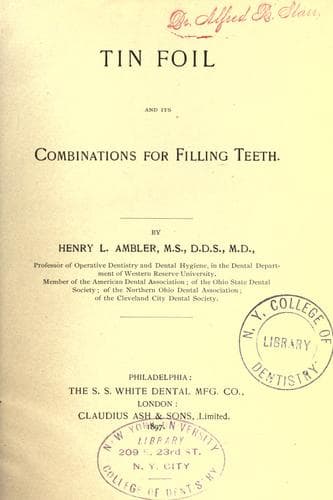
Tin Foil and Its Combinations for Filling TeethAmbler, Henry Lovejoy
Science
Tin Foil and Its Combinations for Filling Teeth
Ambler, Henry Lovejoy
Dentistry
(_c_) A sheet of non-cohesive gold, No. 4, is laid on a sheet of tin of
the same number, cut into strips and rolled into cylinders, or folded
into blocks, always in equal portions; then they will unite to the
extent of two leaves. These fillings sometimes become a solid mass about
the color of amalgam, and last very well, as the metals have become
united by electrolysis. An excess of tin will be marked by lines or pits
in the filling, showing where the tin has been disintegrated or
dissolved by the chemical action which occurs on the surface exposed to
moisture.
No doubt, good fillings have been made by the above methods, yet some
were granular, gritty, and were easily removed, while others were quite
smooth and hard; probably in the first instance the proportion of tin
and gold was not proper,--that is, not equal; or it was not well
condensed. Tin being the positive element, it is more easily acted on
and disintegrated by electrolysis (chemical action of the fluids).
When this combination does become hard, it wears longer than tin on an
occlusal surface, but we believe that in some cases where it was used
the teeth could have been saved just as well with either tin or gold, or
by filling part of the cavity with tin and the rest with gold.
If tin foil is laid on 22-carat gold and vulcanized, it becomes
thoroughly attached and will take a tin polish; the attraction or
interchange of atoms takes place to this extent.
This combination of tin and gold can be used at the cervical margin, or
a cavity can be lined with it, and the remainder filled with cohesive or
non-cohesive gold.
Public-domain text, read in full here on John Shaqi.
Reviews
Reviews
No reviews yet
Be the first to share your thoughts on this work.
Join the Discussion
Join the discussion
Sign in to leave a comment or review.
Sign InorCreate an account