Tin Foil and Its Combinations for Filling Teeth — John Shaqi
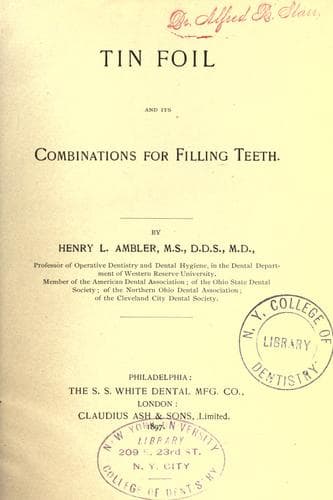
Tin Foil and Its Combinations for Filling TeethAmbler, Henry Lovejoy
Science
Tin Foil and Its Combinations for Filling Teeth
Ambler, Henry Lovejoy
Dentistry
"In the interglobular spaces there is a substance which is called
amorphous or structureless, and a filling to be in harmony with this
substance should be amorphous or structureless in its composition. The
only materials we have which meet these conditions are gutta-percha and
tin. It is its structureless character that gives to tin its value.
Coming in contact with the living dentin, it is easily adapted, and does
not excite inflammation; it does not interfere with the process going on
within the teeth to heal the lesion caused by caries. A wound from a
bullet made of tin, unless it struck a vital part, nature would heal,
even if the cause of the wound was not removed, by encysting the ball.
This process of nature of repairing injury by encysting the cause is of
interest to the dentist in the study of suitable filling-materials. Tin
is very useful at the cervical margin of cavities; it acts as an
antiseptic or preservative, and reduces the liability to subsequent
decay. It is our endeavor to obtain a filling that will preserve the
teeth and reduce the liability to, if not wholly prevent, secondary
decay. The law of correspondence is of more consequence than the
mechanical construction of the filling. Tin can be used without that
rigid adherence to mechanical rule that is necessary to retain a filling
of cohesive gold; thus less of the tooth needs to be sacrificed.
"Gold will unite with tin under certain conditions so as to form
apparently a solid mass. By a combination of these metals, not by
interlacing or incorporating one in the other, but by affinity, secured
by simple contact, we have all the preservative qualities of tin
combined with the indestructible properties of gold. For the base of the
filling we have a material in harmony with tooth-substance, introduced
in a way that is in accord with the law that governs all living bodies,
and for the outside a crystalline substance that corresponds to the
covering of the teeth. This covering of gold is a perfect shield to the
base, and the field for the display of artistic skill in restoring
contours is as broad as though gold was used entirely. Will a filling of
this kind withstand mastication? There is in the economy of nature a
provision made to overcome the resistance of occlusion. The teeth are
cushioned in the jaw and yield under pressure. The elasticity of the
substance of which the teeth are made is well understood. Ivory is the
most elastic substance known. The teeth coming together is like the
percussion of two billiard balls. Now a filling to save the teeth should
correspond as nearly as possible with the tooth-substance; it should not
be arbitrary, but elastic and yielding. Tin is interdigitous; it expands
laterally, and is almost as easily introduced as amalgam, and when put
in place does not have to be bound to be retained. Tin, with an outside
covering of gold to protect it, makes a filling to which amalgam bears
no comparison.
Public-domain text, read in full here on John Shaqi.
Reviews
Reviews
No reviews yet
Be the first to share your thoughts on this work.
Join the Discussion
Join the discussion
Sign in to leave a comment or review.
Sign InorCreate an account