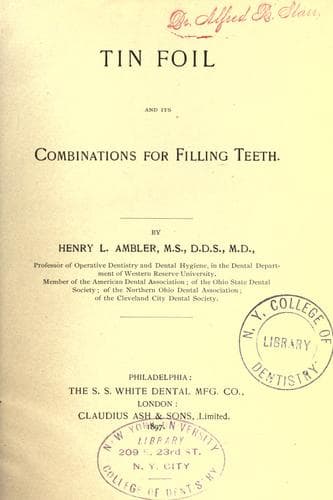
Tin Foil and Its Combinations for Filling TeethAmbler, Henry Lovejoy
Science
Tin Foil and Its Combinations for Filling Teeth
Ambler, Henry Lovejoy
Dentistry
To fuse a tin wire one centimeter in diameter requires a fusing current
of electricity of 405.5 amperes. Up to 225 deg. C., the rise in resistance
to the passage of an electric current is more rapid in tin than in gold.
In some minerals the current follows the trend of the crystals.
Gold wire coated with tin, and held in the flame of a Bunsen burner,
will melt like a tin wire. At 1600 deg. to 1800 deg. tin boils and may be
distilled.
CHAPTER II.
The largest and most complete dental library in the world is owned by
Dr. H. J. McKellops, of St. Louis. Upon his cheerful invitation, the
writer visited that "Mecca," and through his kindness and assistance a
complete search was made, which resulted in obtaining a great portion of
the following historical facts with reference to the use of tin in
dentistry:
"In 1783 I stopped a considerable decay in a large double under tooth,
on the outside of the crown or near the gums, with fine tin foil, which
lasted for a good number of years." ("A Practical and Domestic Treatise
on Teeth and Gums," by Mr. Sigmond, Bath, England, 1825.)
"Fine tin foil or gold leaf may be injected into a cavity successfully,
and retained securely for many years." (Joseph Fox, Dover, England,
1802.)
"The statement has been made several times that tin foil was used in the
United States for filling teeth as early as 1800, at which time
dentistry began to be cultivated particularly as a science and art, and
was beginning to be regarded as of more importance than it formerly had
been. The writer has not found any record of its use in this country
earlier than 1809. Tin may often be employed with entire confidence. I
have seen fillings forty-one years old (made in 1809) and still perfect.
Several molars had four or five plugs in them, which had been inserted
at different periods during the last half-century. I prefer strips cut
from six sheets laid upon each other. If the foil is well connected, the
cut edges will adhere firmly; if they do not, the foil is not fit for
use." (Dr. B. T. Whitney, _Dental Register of the West_, 1850.) First
reference to the fact that tin is adhesive.
"Tin is desirable in all unexposed cavities. It has a stronger affinity
for acetic, citric, tartaric, malic, lactic, and nitric acids than the
tooth has: a good material where the secretions are of an acid
character, it is better that the filling should waste away than the
tooth. One cavity in my mouth was filled with gold, decay occurred, the
filling was removed; cavity filled with oxychlorid, which produced pain;
filling removed; cavity filled with gutta-percha, still experienced
pain; filling removed; cavity filled with tin, and pain ceased in an
hour. A tin filling was shown in New York which was sixty years old;
made in 1811." (Dr. E. A. Bogue, _British Journal of Dental Science_,
1871.)
Public-domain text, read in full here on John Shaqi.
Reviews
Reviews
No reviews yet
Be the first to share your thoughts on this work.
Join the Discussion
Join the discussion
Sign in to leave a comment or review.
Sign InorCreate an account