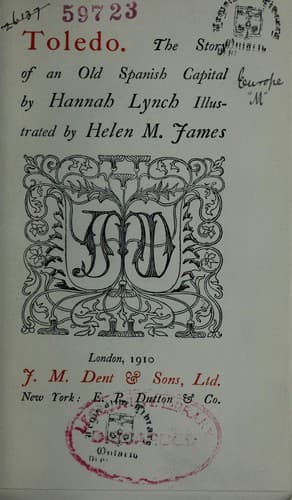
Toledo, the Story of an Old Spanish CapitalLynch, Hannah
History
Toledo, the Story of an Old Spanish Capital
Lynch, Hannah
Toledo (Spain) -- Description and travel; Toledo (Spain) -- History
division of the apse are chevroned and increased in number, this being
the only portion of the early work in which any, beyond transverse and
diagonal ribs, are introduced. There is a weakness and want of purpose
about the treatment of this highest portion of the wall that seems to
make it probable that the work, when it reached this height, had passed
out of the hands of the original architect. In the nave the original
design (if it was ever completed) has been altered. There is now no
trace of the original clerestory and triforium which are still seen in
the choir, and in their place the outer aisle has fourteenth century
windows of six lights with geometrical tracery, and the clerestory of
the nave and transepts great windows, also of six lights, with very
elaborate traceries. They have transomes (which in some degree preserve
the recollection of the old structural divisions) at the level of the
springing of the groining. The groining throughout the greater part of
the church seems to be of the original thirteenth century work, with
ribs finely moulded, and vaulting cells slightly domical in section. The
capitals of the columns are all set in the direction of the arches and
ribs they carry, and their abaci and bases are all square in plan."
Street is of the opinion, based upon the singular purity of this
vigorous specimen of Gothic of the thirteenth century, that the
architect must have been French, or at least a Spaniard who had lived
for years in France, and studied the best French churches. The
architect, we learn, was Pedro Perez, whose name we gather from the
Latin epitaph:
_Aqui: jacet: Petrus Petri: magister_
_Eclesia: Sete: Marie: Toletani: fama:_
_Per exemplum: pro more_: huic: bona:
_Crescit: qui presens: templem: construxit:_
_Et hic quies cit: quod: quia: tan: mire:_
_Fecit_: vili: sentiat: ire: ante: Dei:
_Vultum: pro: quo: nil: restat: inultum:_
_Et sibi: sis: merce: qui solus: cuncta:_
_Coherce: obiit: X dias de Novembris:_
_Era: de m: et CCCXXVIII._ (_A.D. 1290_).
Street suggests that Petrus Petro may more probably have meant the
French Pierre, son of Pierre, than the Spanish translation of Pedro
Perez, but putting one uncertainty against another, the Toledans are
perfectly right to hold out for their dubious compatriot, Pedro Perez.
[Illustration: NORTH TRANSEPT DOOR OF CATHEDRAL]
Public-domain text, read in full here on John Shaqi.
Reviews
Reviews
No reviews yet
Be the first to share your thoughts on this work.
Elsewhere in the archive
Join the Discussion
Join the discussion
Sign in to leave a comment or review.
Sign InorCreate an account