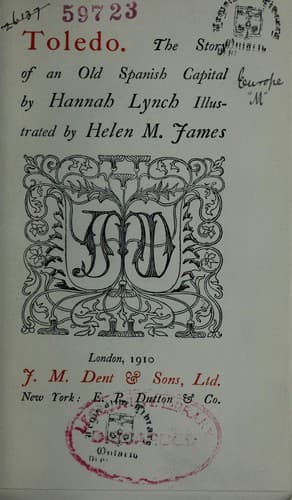
Toledo, the Story of an Old Spanish CapitalLynch, Hannah
History
Toledo, the Story of an Old Spanish Capital
Lynch, Hannah
Toledo (Spain) -- Description and travel; Toledo (Spain) -- History
In spite of the enormous height of the Cathedral, the spectator is not
at first impressed with this fact, owing to the immensity of its
dimensions and the vastness of the columns that support the vaults. But
the impression of spaciousness is, on the contrary, insistent, and this
by the beautiful simplicity and classical uniformity of the whole. When
you have recovered the first stupendous shock of admiration, you will
wonder where to begin in your exploration. If you enter by the north
door, which is the first you will meet coming from the Zocodover, you
will at once be confronted with the wonderfully wrought screen of the
Coro. Inside and out this choir is rich in interest. First there is the
railed entrance to examine. Before the Napoleonic war, this railing, as
well as the _Reja_ of the Capilla Major, opposite, was silver-plated and
heavily gilt, but at the time of the French invasion, it was designed to
save it from ruthless hands by concealing its value under an iron
coating. The inventor of this stain succeeded so well that never since
has anyone been able to clean the railings, which now only show here and
there a gleam of the covered plate. Domingo de Céspedes, aided by
Fernando Bravo, designed this handsome work. Nothing finer than the
ornamentation could be imagined. The arms of Cardinal Siliceo and those
of Diego Lopez de Ayala, one of the great Toledan families of the Middle
Ages, are worked into the design, along with the inscriptions: _Pro cul
esto prophani_ and _Psale et psile_. To attempt anything like a detailed
description of so much elaborate work as the impressive screen round the
choir, or the interior multiplied creations of Berruguete and Philip of
Burgundy, of Vergara and Rodrigo, would demand an entire book upon the
Cathedral alone. The sculptures of the screen are most varied and
beautiful, and repay careful study. The subjects are separated by light
arches and supported on jasper columns. Above are fifty-eight reliefs of
biblical scenes, and the whole forms an admirable combination of
decorative richness and delicacy, unfortunately spoiled by later and
incongruous additions and improvements. Of the famous choir seats
everybody has heard. The thirty-five upper seats on the gospel side are
the work of Philip of Burgundy, the seats on the epistle side are
Berruguete's work. It is a matter of taste which of the two is the
better. Some foreign critics prefer Vigarny's sculpture as more delicate
and more finished; while all Spaniards give their preference to
Berruguete, one of the national idols, and delight in his more exuberant
genius. Writing of the three ranks of stalls of this truly marvellous
choir, Théophile Gautier says: "l'art Gothique, sur les confins de la
Renaissance, n'a rien produit de plus parfait ni de mieux dessiné."
Antonio Ponz in the last century wrote of it: "The sculpture of the
choir has been and always will be the great admiration of the
Public-domain text, read in full here on John Shaqi.
Reviews
Reviews
No reviews yet
Be the first to share your thoughts on this work.
Elsewhere in the archive
Join the Discussion
Join the discussion
Sign in to leave a comment or review.
Sign InorCreate an account