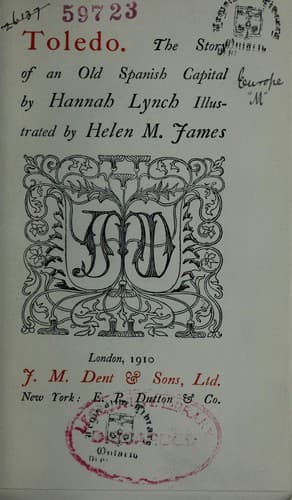
Toledo, the Story of an Old Spanish CapitalLynch, Hannah
History
Toledo, the Story of an Old Spanish Capital
Lynch, Hannah
Toledo (Spain) -- Description and travel; Toledo (Spain) -- History
Space forbids anything like a detailed account of the chapels and
cloisters of the Cathedral. These latter are not to be compared with
most of the other Spanish cloisters,--with, for instance, those of
Segovia, of Santiago, of Burgos or Oviedo. There is the inevitable
felicitous contrast of foliage and columned arch, and here, certainly,
the note is more joyous than elsewhere, with the deep yellow light
striking radiantly upon this large, airy square of sun-shot leafage open
to the heavens. The cloisters were built by Cardinal Tenorio, and Blas
Ortiz, a contemporary Toledan of Philip II. describes them in his
beautiful caligraphy, preserved in the _Biblioteca Provinciale_, as
"sumptuous." This is a favourite adjective with the Spaniards who write
about Toledo. It saves a multiplicity of explanations. The frescoes on
the walls, painted by Bayeu after the manner of Vanloo, represent scenes
from the life of St Eugenius and the famous legend of the _Niño
perdido_. They are decorative but not interesting, and Gautier
pronounces them out of keeping with the austere elegance of the
architecture. It must be earlier paintings, since effaced, that Blas
Ortiz describes as _perfectissime_. The fine door of the Presentation, a
good specimen of _plateresca_ work, was wrought by Pedro Castañeda, Juan
Vasquez, Toribio Rodriguez, Juan Manzano, and Andréz Hernandez. The
design and the reliefs are well worth careful examination. The _portada
de Santa Catalina_ commands attention. It is excessively decorated, and
bears the arms of Spain and of the Tenorios; one of the finest details
of the façade is the statue of St Catherine holding in one hand the
wheel and in the other the sword, emblems of her martyrdom. Historical
value is attached to Bayeu's frescoe representing the reception at
Toledo of the bones of St Eugenius, 1565. Philip II. and his son are
there, as well as the archdukes Rudolph and Ernest, and there is a view
of the Puerta Visagra through which the procession entered. Other
frescoes treat of the Moorish saint Casilda, and on the north side is
the chapel of St Blaise, built also by Tenorio as his coat of arms
indicates. On a pedestal within a railing is a fragment found near St
John of the Penetencia testifying to the date of the consecration of the
Cathedral.
Public-domain text, read in full here on John Shaqi.
Reviews
Reviews
No reviews yet
Be the first to share your thoughts on this work.
Elsewhere in the archive
Join the Discussion
Join the discussion
Sign in to leave a comment or review.
Sign InorCreate an account