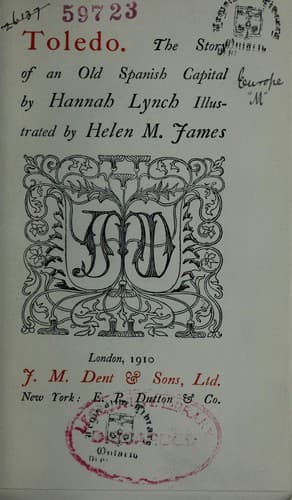
Toledo, the Story of an Old Spanish CapitalLynch, Hannah
History
Toledo, the Story of an Old Spanish Capital
Lynch, Hannah
Toledo (Spain) -- Description and travel; Toledo (Spain) -- History
There is small space to dwell upon the incredible value of the church
treasures, only shown at stated periods. Seven canons open the seven
doors, each with a separate key. The hour for showing these matchless
splendours is 3 P.M., a bad one on account of the light, and the
miserable candle the sacristan carries is of small use. Here will you
see pearl and precious stones, embroidered mantles, such jewels and gold
and silver brocade as surely the eye of man never elsewhere beheld--the
rarest of wrought cloaks and robes and laces--all royal presents, or the
gifts of cardinals to the Virgin of the Sagrario. The Custodia is, for
sheer magnificence, a thing to gape at. It is the work, rather the
monument, of a German silver-smith, Henry of Arfe, and his son and
grandson. The guide-book describes it as of an unheard-of wealth in
jewels, gold work and chiselling. To attempt its description would
involve me in another chapter on the Cathedral. Perhaps the most
precious thing of all among so many treasures is the sad and mystical
wood statue of St Francis of Assisi, by Alonso Cano, some say, by his
pupil, Pedro de Mena, later critics aver. Unfortunately, it is vilely
placed in a corner, and as well, just in the middle of the face, the
glass cover is broken, so that it is difficult to obtain a real view of
the head without some portion of the features distorted.
The object of the devotion of the Chapel of the Treasury is a statue of
the Virgin, which Our Lady is said to have kissed on her descent from
heaven to bestow the chasuble on St Ildefonso. Hence the astounding
mantle embroidered by Felipe Corral, made of gold, pearls, rubies,
sapphires and emeralds. Other notable treasures are the charming
specimens of silver repoussé--one, the Rape of the Sabines, so
beautifully wrought as for years to have been attributed to Benvenuto
Cellini. To-day, the Flemish artist, Mathias Méline, is recognised as
the creator. It was the gift to the church of Cardinal Lorenzana. The
big silver figures on four globes, with belts and sandals all gleaming
with jewels, belong to the time of Felipe II. They command attention,
even in all this magnificence of precious metal, precious stones, silk,
lace and art; but I do not know who made these statues that represent
the four parts of the world.
Public-domain text, read in full here on John Shaqi.
Reviews
Reviews
No reviews yet
Be the first to share your thoughts on this work.
Elsewhere in the archive
Join the Discussion
Join the discussion
Sign in to leave a comment or review.
Sign InorCreate an account