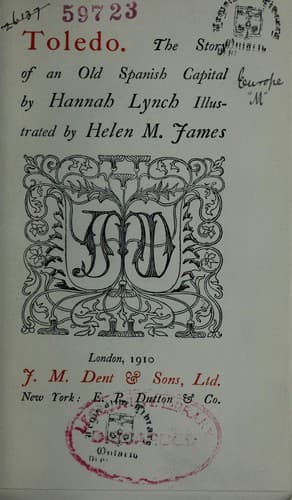
Toledo, the Story of an Old Spanish CapitalLynch, Hannah
History
Toledo, the Story of an Old Spanish Capital
Lynch, Hannah
Toledo (Spain) -- Description and travel; Toledo (Spain) -- History
The _Ochavo_ is like everything here, an impressive chamber, the home of
vast treasure. It is a monument of bronze and marble, containing massive
silver coffins wonderfully wrought for the bones of St Leocadia and St
Eugenius, statues of silver and ivory, and priceless reliquaries. Behind
are guarded the church vestments. Nowhere are such embroideries and
brocades to be seen. The hundred altar-pieces are works of art to set
the mouth of the collector awatering. The older they are the more
lovely, and beside the early Gothic brocade-embroidery, the finest
effort of the last century seems poor and vulgar, though seen apart
would cause the beholder to exclaim at its loveliness. Whence did these
rude Goths obtain their secret of such exquisite work? and how has it
died from amongst us? Were the sacristan willing, and human nature
capable of such a prolonged effort of admiration, one might spend days
among these gold and silver embroidered brocades, and complacently dream
of impossible times. But when the sacristan has shown you a dozen
chasubles and a dozen altar-pieces, he thinks it quite enough--and so do
you, wearied from excess of strain upon admiration and ravenous envy.
The beautiful and massive tower which lends majesty to an exterior not
nearly so impressive as the interior of the Cathedral, was begun by
Rodrigo Alfonso in 1380, but the work went on very slowly until the
Archbishop Contreras put it into the hands of the architect, Alvar
Gomez, who finished it (1440). There have been changes since, especially
in 1660, when the capital was burnt and rebuilt. It is worth while to
ascend the interminable stairs to the belfry, not to marvel at the
largest bell, I believe, of the world, whose terrible note reaches as
far as Madrid, but to revel in the view. You seem to look down upon the
earth from Alpine heights. Below, through incredible depths of space,
flows the Tagus, with its broad horse-shoe curve that makes almost an
island of the town, and with charming little breaks in joyous verdure
and soft little dashes of blue shade and white mist, the sombre and
austere hills of Toledo make an upper and more violent rampart against
the world beyond. Such is the sense of imprisonment here, that the eye
instinctively seeks, as a chance of escape, the long white way of
Madrid. It is good to breathe a moment in so exalted an atmosphere, to
behold so vast and wonderful a scene, in which all remembrance of human
miseries vanishes, and our very joys drop into relative significance.
Nature has nowhere else attained a note of beauty harsher, more intense,
more indifferently sublime. Elsewhere you feel that an effort has been
made to captivate you, a deliberate combination of effects to win your
admiration. Not so here. The Moors never succeeded, during their long
sovereignty, in stamping the place with their voluptuous charm, as they
did in Granada, Cordova, and Valencia. They left it as they found it,
Public-domain text, read in full here on John Shaqi.
Reviews
Reviews
No reviews yet
Be the first to share your thoughts on this work.
Elsewhere in the archive
Join the Discussion
Join the discussion
Sign in to leave a comment or review.
Sign InorCreate an account