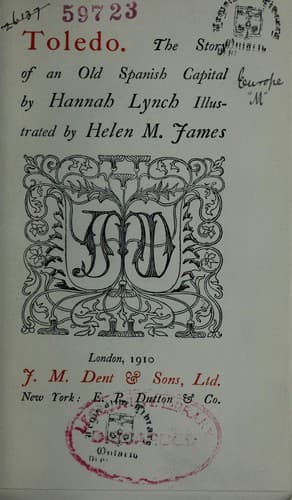
Toledo, the Story of an Old Spanish CapitalLynch, Hannah
History
Toledo, the Story of an Old Spanish Capital
Lynch, Hannah
Toledo (Spain) -- Description and travel; Toledo (Spain) -- History
the stern home of revolt, the nest of mailed warriors and hardy
artisans, so hard and quarrelsome that not even their loves furnish us
with a soft legend, nor their literature a witching profile, or any hint
of seductive grace in their womanhood.
[Illustration: THE CATHEDRAL TOWER]
CHAPTER VII
_Domenico Theotocopulos_ El Greco
There is but one great painter permanently and almost exclusively
associated with Toledo, _El Greco_. All the notable pictures of the town
are his, and so vast is his work here, that the Toledan churches possess
at least fifty pictures of his, a dozen of which are nothing less than
masterpieces, and the rest the work of a master in weaker and more
erratic moments.
Masters are so rare in the history of this world that one would gladly
know something of this tardily recognised great one; learn the secret of
his preposterous defects in the second stage of his development, and the
no less enigmatic secret of his occasional reach to supreme perfection.
How came the man who could paint the glorious under picture of the
Burial of Count Orgaz (see illustration), to draw and paint the
inconceivable picture of St John the Baptist in the _hospital de
Afuera_? How, in fact, rose the absurd legend of his madness, since no
details of the man's life has reached us on which to base such an idea?
Théophile Gautier, with lamentable flippancy, gives echo in France to
the ill-natured supposition of Palomino, the least trustworthy of
guides. Nearly every fact given by Palomino concerning _El Greco_ is
false. He states the painter's age, though no mortal being, contemporary
of _El Greco_, or researcher of our own times, has the faintest ground
for any such statement. The registrar of his death, which a Spanish
painter, an impassioned student of all that concerns _El Greco_, has
seen, proves that the artist's age was uncertain, since nobody about him
knew the date of his birth. Furthermore, Palomino tells us triumphantly
that _El Greco_ was buried in the parish of San Bartolomé, "and instead
of a slab they placed a railing over his grave to indicate that nobody
else should be buried there." The church fell down years afterwards, he
assures us, and the place of _El Greco's_ burial was no longer known.
This is all mere supposition, just as Palomino's statement of _El
Greco's_ age, seventy-seven, and more innocent in the way of loose
statements than his information that Theotocopulos went mad with rage
from hearing himself compared with Titian, and purposely distorted his
work to extinguish a similarity that did him honour. Such is the flimsy
tale so genial and witty a writer as Gautier lightly spreads.
Public-domain text, read in full here on John Shaqi.
Reviews
Reviews
No reviews yet
Be the first to share your thoughts on this work.
Elsewhere in the archive
Join the Discussion
Join the discussion
Sign in to leave a comment or review.
Sign InorCreate an account