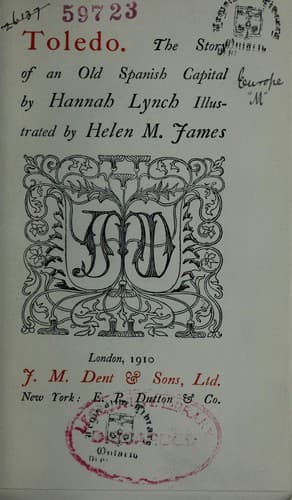
Toledo, the Story of an Old Spanish CapitalLynch, Hannah
History
Toledo, the Story of an Old Spanish Capital
Lynch, Hannah
Toledo (Spain) -- Description and travel; Toledo (Spain) -- History
_El Transito_ was seized by Isabel the Catholic, on her expulsion of the
Jews from her kingdom, and handed over to the Knights of Calatrava,
whose arms are stamped on every corner of the temple. The Knights did
what every other religious body in all ages and lands has done on taking
possession of the temple of the dethroned gods. They marred the harmony
of Eastern architecture by the erection of Christian altars, less
flagrantly, of course, than the great Mosque of Cordova was marred. But
still the false note is there: it greets us with singular bad taste in
the fifteenth century retablo, in a _plateresca_ altar, in mediocre
sixteenth century paintings that represent scenes from the New
Testament, oddly unsuitable to the walls of a synagogue, and out of
keeping with the long Hebrew inscriptions in relief above the frieze.
Some of these meritless canvases are attributed to John of Burgundy.
There is a choir neither decorative nor impressive, and a plateresca
door, a tolerable specimen of that Spanish architecture. These are mere
blots upon a graceful whole. The Jews under Moorish influence, built
this lovely little temple, and its spirit, its essence, its genius,
remain Jewish after more than four centuries of dispossession.
The origin of the name _Santa Maria la Blanca_ dates from the fourth
century, when Our Lady, in a miraculous vision, is said to have chosen
the spot for the erection of a church in her honour, which was covered
with snow. Pope Liberius then ordered the church to be built and
consecrated to the White Lady--_Nuestra Señora la Blanca_. Later, the
church became the property of the Jews, who rebuilt above its ruins the
imposing synagogue we see to-day, in the Moorish ninth century style.
Unhappily for them St Vicente Ferrer, a mediaeval fanatic who to-day
would be called a demagogue, came to Toledo in 1405, on his famous
crusade against the unfortunate race. You may see the highly sculptured
pulpit half Moorish, half Gothic, he preached his frantic sermons from
to the inflammatory Toledans in the little church of Santiago below the
Puerta del Sol, now closed up with a wooden statue of the saint in the
middle, holding in one hand a wooden crucifix, and flourishing the other
in exhortation to the populace to destruction and cruelty. The Man of
Sorrow, who preached peace and goodwill to all men, love of enemies,
forgiveness of injuries, himself a Jew, son of a Jewess, is held up to
excite the furious passions of the mob, to urge them to crime and
infamous injustice. How much fatal misery humanity in all ages, even in
our own, might have been spared by the prevalence of so small a quality
as a sense of humour! The Valencian saint himself died in bleak far-off
Vannes, in Brittany.
Public-domain text, read in full here on John Shaqi.
Reviews
Reviews
No reviews yet
Be the first to share your thoughts on this work.
Elsewhere in the archive
Join the Discussion
Join the discussion
Sign in to leave a comment or review.
Sign InorCreate an account