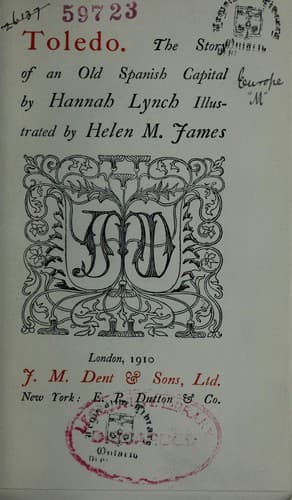
Toledo, the Story of an Old Spanish CapitalLynch, Hannah
History
Toledo, the Story of an Old Spanish Capital
Lynch, Hannah
Toledo (Spain) -- Description and travel; Toledo (Spain) -- History
But there was no humour then in grim and blood-saturated Toledo. The mob
rushed from the church to the synagogue, tore the obnoxious Jews limb
from limb, thrust them into the streets and the highways, robbed,
tortured, wounded, took possession of their beautiful temple, sacked
their houses, carried off their money-bags, (naturally), hooted, hissed,
and kicked them precisely as it would to-day in Paris, for all our
enlightenment and progress, if it dared. All this in the pacific name of
Christ! Centuries after the synagogue became a Magdalen's Asylum, under
Cardinal Siliceo, until 1791, when it was converted into a barrack and
military stores. It was only rescued from this ignoble use thirty years
ago, and restored by public subscription.
Nothing could be more miserable than the exterior of _Santa Maria la
Blanca_; nothing more squalid than its surroundings. A deserted quarter,
mean little laneways, towzled babies, unfortunate beggars. "As soon as
you descend the steps that lead to it," writes Quadrado, "you are
arrested by the surprise of this singular mingling of magnificence and
nakedness, of capricious strangeness of lines, the exquisite taste of
the ornaments; you fancy yourself transported to a fantastic pagoda. The
glance is lost in the midst of this forest of great octagonal pillars,
which from the point of view of proportion, lack half of their height.
They are seven in a line, forming five naves, and holding Moorish arches
of a bold curve. The capitals in stucco are of different forms, composed
of branches, of leaves and garlands, mixed with fir-cones, reminiscences
of the old Byzantine style. Varied ornaments, arabesques, lovely rose
windows along with arches, and prominent above the central nave a frieze
in slight relief, formed of lines crosswise and intermingling, and even
still of a remarkable precision and purity. No dome, not even a ceiling;
a roof of wood, of miserable aspect, descending from the height of the
central nave to the two lateral extremities, gives to the whole edifice
an appearance of ruin and abandonment." The restorers, with customary
clumsiness, have coated the whole temple in plaster, like the cloisters
of San Juan de los Reyes, with a result almost facetious, taking into
consideration the name of the building. It is now white with a sorry
vengeance. The ceiling is said to have been made from beams of the
cedars of Lebanon, and the soil the synagogue is built upon to have been
brought from Mount Zion. The Moorish and Byzantine style mingle most
artistically, with the accumulated delicate and artistic effects of both
and the enchanting azulejos, here of an admirable beauty of colour and
design; but arabesque, tiles and horse-shoe arches are sadly out of
harmony with the Gothic altars of the chancel. One finely sculptured, is
supposed to be by Berruguete or one of his pupils. Elsewhere it would
show to better advantage than here. Curious detail, the wells may still
Public-domain text, read in full here on John Shaqi.
Reviews
Reviews
No reviews yet
Be the first to share your thoughts on this work.
Elsewhere in the archive
Join the Discussion
Join the discussion
Sign in to leave a comment or review.
Sign InorCreate an account