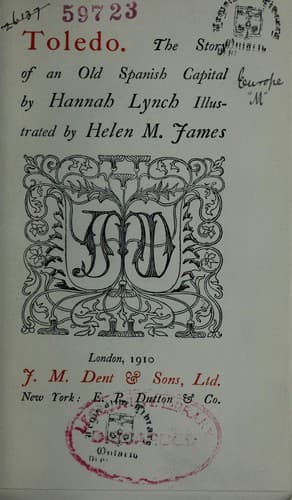
Toledo, the Story of an Old Spanish CapitalLynch, Hannah
History
Toledo, the Story of an Old Spanish Capital
Lynch, Hannah
Toledo (Spain) -- Description and travel; Toledo (Spain) -- History
The _Corral_ of Don Diego is an extensive courtyard near the church of
the Magdalena, said to have been the property called the _Barrio del
Rey_, which Alfonso, after the Conquest, gave to Don Pedro Paleologus,
who came to Toledo to fight the Moor, and remained to found the great
house of the Toledos. The arms of the Toledos may still be seen above
the gates, and Henry of Trastamare, we are told, bestowed the palace
upon his auxiliary, Bertrand de Guesclin, with the title of Trastamare,
which has since fallen to the Duke of Montemar. Nothing now remains of
the palace but the courtyard, and a magnificent Moorish archway of
horse-shoe shape, and arabesques recalling the style of the Alcázar of
Seville, but we may gather some notion of its size and importance from
the ruin. There are indications miserably faint and buried away under
plaster, that the palace was richly ornamented in the mudejar style.
Inscriptions, Moorish arches, and ajimez windows are dimly discoverable
beneath the broken plaster-work and the primitive roughness of modern
repairs. An impression of splendid halls and chambers, of delicately
ornamented Moorish alcoves and boudoirs and inscriptions, of artesonado
ceilings and emblazoned doors, is seized under the frost of neglect,
through the mildew of centuries, the wood-work, design, and gilt of the
octagonal ceilings now almost hopelessly obliterated, and the friezes
mere shapeless dilapidation.
The Castillo de San Servando or Cervantes, just outside the Bridge of
Alcántara, is an impressive looking ruin, that seems mysteriously to
have become inter-penetrated with the burnt and arid tones of the
landscape. It has no historic or architectural interest whatever, is not
even beautiful, but impresses the eye in its decay, with its rough,
battlemented, and scarred visage, the ancient note of its barbican and
square rude towers. It is indubitably Mozarabe, built by the Moors as a
fortress, and employed as such by Alfonso after the Conquest. Calderon
makes mention of it in _Cado uno por se_, and in the civil war of Pedro
and Henry of Trastamare, having been abandoned by the Knights Templars,
whose property it had become, it resumed its use as a strong place. The
Archbishop Tenorio ordered its repair, and many of the arches and vaults
date from this period. Tramps now sleep comfortably in its shadow, and
scare you in your moonlit walks by midnight.
Public-domain text, read in full here on John Shaqi.
Reviews
Reviews
No reviews yet
Be the first to share your thoughts on this work.
Elsewhere in the archive
Join the Discussion
Join the discussion
Sign in to leave a comment or review.
Sign InorCreate an account