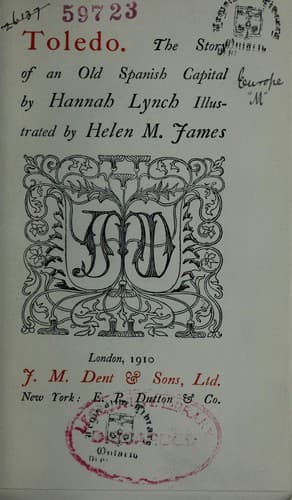
Toledo, the Story of an Old Spanish CapitalLynch, Hannah
History
Toledo, the Story of an Old Spanish Capital
Lynch, Hannah
Toledo (Spain) -- Description and travel; Toledo (Spain) -- History
Santa Fé was originally a royal Moorish palace beautifully situated on
the north edge of the Zocodover, which Alonso VI., the conqueror, at the
instance of his French queen Constance, bestowed upon a French order for
noble ladies. A charming and perfect suggestion of its antique moresque
beauty may be had from the view of its wall in an old garden above the
river where you see the Moorish apse and brick arcading. The ground
covered by the palace must have been enormous, since in the time of
Alfonso VIII. the priory of the Knights of Calatrara was established
here. Nothing now remains but the Moorish choir and arcaded wall, and
the best of it is to be seen from the wild patch of garden outside the
convent walls. It is another case of senseless destruction, a monument
we are only permitted to rebuild in imagination with the help of a few
Moorish arches and brown brickwork half-hidden by exuberant foliage. A
stately dream, if mournful and evanescent, San Juan de la Penitencia
ineffectively situated below the Cathedral in a broken and dilapidated
quarter, is a Franciscan convent founded by Cisneros for poor girls,
where after six years' free schooling they may remain as nuns, and if
they prefer marriage the convent dowers them with about £15, with a
life-seat in the choir. The church is one of the minor sights of Toledo.
It was finished by the secretary of Cisneros, who lies buried here,
Francisco Ruiz, Bishop of Avila. About the convent halls and corridors
are still traces of Moorish ornamentation in which the Castillian
conquerors delighted quite as much as the Moslem. The chapel ceiling is
a good specimen of artesonado in terrible decay alas, and the
architecture is a medley of Gothic, Moorish, and renaissance. Above the
porch are the arms of Cisneros. Within it is of a gloomy and depressing
simplicity: a single nave, a high altar, a tribune. True the plateresca
frieze of the tribune is graceful, and the iron railing of the high
altar is quite the best of the minor churches, and admirably decorative,
while the tomb of the Bishop of Avila brought from Palermo is a most
beautiful work of art. Writing of it, Ponz says:--"Above a large stone
divided by three pilasters to form three pedestals, there are an equal
number of statues seated, almost life-size, representing Faith, Hope,
and Charity. Between the pilasters are the arms of the Bishop, five
castles. In a framed niche are contained the urn, couch, and recumbent
statue. In front of the urn there are two weeping children, and in the
depths of the niche four angels hold up the curtains. On either side are
two Doric pillars sustaining the architecture, frieze, and cornices,
and along the frieze runs: _Beato mortui, qui in Domino moriuntur_. On
the edge are two wrought columns of a very antique taste, excellently
executed.... Between these columns and pilasters on either side is a
statue, St James and St Andrew, and above the figures of children. Over
Public-domain text, read in full here on John Shaqi.
Reviews
Reviews
No reviews yet
Be the first to share your thoughts on this work.
Elsewhere in the archive
Join the Discussion
Join the discussion
Sign in to leave a comment or review.
Sign InorCreate an account