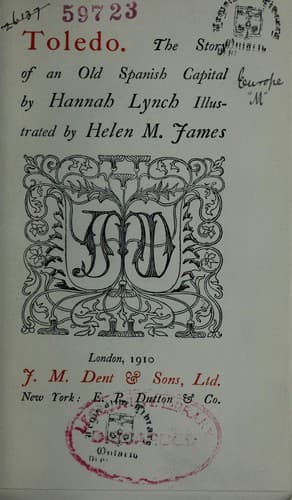
Toledo, the Story of an Old Spanish CapitalLynch, Hannah
History
Toledo, the Story of an Old Spanish Capital
Lynch, Hannah
Toledo (Spain) -- Description and travel; Toledo (Spain) -- History
The church is situated under the ruins of the old city walls, below the
Puerta del Cambron. It is rough and simple enough, and derives its name
from the wooden crucifix over the altar, to which legend attaches a
romantic interest. Becquer and Zorilla have told the tale in thin and
sentimental prose, and in thinner and more sentimental verse. A gallant
pledged his word to marry a maid within sight of this crucifix:
afterwards he forgot his promise and denied the pledge, on which the
broken-hearted maid flung herself at the foot of the crucifix, and
addressed it as the witness of violated vows. The crucified held out a
wooden arm, and a voice from above exclaimed, "_I testify_." There is
one lovely thing in this quaint old basilica, the statue of St Leocadia
by Berruguete, originally sculptured for the gate of Cambron. Nothing
more sweet and delicate was ever wrought by that famous hand; no more
fitting expression of brave and beautiful maidenhood was ever conceived
in stone; and Italian influence in its best form is here visible, and
Berruguete's strength is subtilised by an exquisite and penetrative
charm. As well as St Leocadia and St Ildefonso, an Arabian inscription
in relief tells us that the first Moorish King of Toledo, Mahomad
Ben-Raman, was buried here.
Some of the convents of Toledo have been famous. That of San Pedro de
las Dueñas, in the reign of Henry the Impotent, created quite a
scandalous interest. Tired of his mistress, Doña Catalina de Sandoval,
he insisted on naming her abbess of this convent, and with this object
ordered the public expulsion of the abbess, the Marquesa de Guzman. In
his pretence lies the humour of the situation: he found the convent
needed a purifying influence, and that the ladies were not sufficiently
scrupulous in the maintenance of their vows. Spanish convents, before St
Theresa's time, were not harsh abodes. Indeed, I fancy they were freer
and pleasanter dwellings than the home of father or husband. Cavaliers
thronged the parlours, and there was much thrumming of lute and guitar,
much singing of soft sequidilla between belted knights and veiled
ladies, who only left off these gentle recreations when the bell
summoned them to meal or prayer. However, St Pedro so exceeded the limit
of ecclesiastical tolerance that the Archbishop Alonzo of Carrillo
placed it under interdict, and forbade any priest to cross its
threshold. The scandal only ended with the austere and lofty presence of
Queen Isabel upon the scene.
Public-domain text, read in full here on John Shaqi.
Reviews
Reviews
No reviews yet
Be the first to share your thoughts on this work.
Elsewhere in the archive
Join the Discussion
Join the discussion
Sign in to leave a comment or review.
Sign InorCreate an account