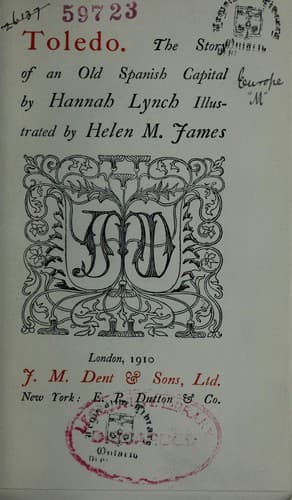
Toledo, the Story of an Old Spanish CapitalLynch, Hannah
History
Toledo, the Story of an Old Spanish Capital
Lynch, Hannah
Toledo (Spain) -- Description and travel; Toledo (Spain) -- History
inscriptions; from the zones of ornamental arches enlaced, bayed above
and horseshoe-shaped beneath, break away other architectural flourishes
of raised ogival, the zones divided by angles with the points inward.
Behind the great arch, there is another horseshoe arch, and above it is
a round medallion, with a relief, of the Virgin offering the chasuble to
St Ildefonso; beyond are two simple ogival arches, united to form the
rising line of the portcullis, and then another horseshoe arch in the
back façade forms the same design. Above are three similar little
arches, with railings, and in the semi-circular tower below are three
apertures for barbaric hostilities, in each façade joining the central
compartment. Each aperture, in front, has an ornamental bayed arch,
placed above three corbels crowned with towers turreted in pyramidal
capitals. Within, a series of Arabian arches--the quadrangular tower
only adorned with little Moorish arches. The age of this most exquisite
gate is uncertain. It is believed to be of the second period of Moorish
architecture in Toledo, that is, tenth century, with alterations as far
as the thirteenth. While the architecture is perfectly Moorish, there is
some indication of Christian influence--in the use of a stone not
generally used by the Moors, and also in the reliefs of the Virgin and
St Ildefonso, and in the little marble relief of the two women and the
man, supposed to perpetuate the tale of the Governor Fernando Gonzalez,
Lord of Yegros, whom San Fernando, that uncompromising king, sentenced
to death for betraying two women: by some believed to represent St John
the Baptist, Herodias and her mother. The simple traveller, who loves
righteousness and truth, will stick to the avenging sovereign sentencing
thus summarily the rascal governor. But it is like the figure in the
central arch of the Bridge of San Martin. Believe what you like best.
Fernando may have boiled his enemies in pots of water over huge logs, or
roasted them alive before roaring fires. He himself was such an
admirable fellow in his private life that we are constrained to believe
his enemies merited such treatment. He died during the third period of
Moorish architecture in Spain, and left all he possessed to the Hospital
of Santiago. It was perhaps a little excessive on the part of St
Fernando, after chopping off the governor's perfidious head, to
confiscate all his property and bestow it on the poor. The governor's
relations might justly have regarded themselves as defrauded. But those
were the happy days when subjects had no rights, and only breathed by
divine permission of the sovereign. Young people who fell in love
without the king's leave were dispatched to prison or a nunnery. In the
leisure that war and revolt occasionally allowed him, the king made and
unmade marriages; and if, glancing from his palace windows, he chanced
to see a man pass by who looked as if, at some future date, he might be
Public-domain text, read in full here on John Shaqi.
Reviews
Reviews
No reviews yet
Be the first to share your thoughts on this work.
Elsewhere in the archive
Join the Discussion
Join the discussion
Sign in to leave a comment or review.
Sign InorCreate an account