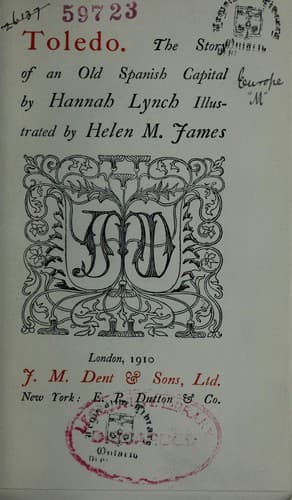
Toledo, the Story of an Old Spanish CapitalLynch, Hannah
History
Toledo, the Story of an Old Spanish Capital
Lynch, Hannah
Toledo (Spain) -- Description and travel; Toledo (Spain) -- History
When you left all this cultivated brilliance of nature, that showed the
passage of the Moors, narrow and stony streets and lanes confronted you
in your upward road from the bridges and gates. Then as now! _Cuestas_
and harsh passages, built upon peaks of rock and iron, Pisa calls them;
twisted and narrow laneways. He accuses the Moors of having spoiled the
town, of having obliterated the lustre and loveliness Roman and Goth
bestowed upon it. This is an ill-tempered charge. The Moors gave in
Spain everywhere more than the Christians lost, and the trial is, seeing
the sad use the Christians made of what they received, to hold one's
soul in patience, and not cry out against their philistinism. He
believes that in Christian hands, "fine places, wide and noble streets,
churches and hospitals will spread." Churches and convents, yes. But the
streets remain the same, an expiation of the sins of civilisation, as
twisted, as narrow, as stony as ever, good Dr Pisa, after eight
centuries of Christian rule.
The present Alcázar, which dominates the city, was first built by the
Cid's sovereign, Alfonso, while the Moorish palace stood on the site of
the monastery of St Augustine. In the parish of San Martin was the
Alcázar of the infante Fadique, Sancho the Brave's uncle, within a
magnificent view of the river and the Vega, its walls running as far as
the Puerta del Cambron. It fell into the hands of Maria de Molina,
Sancho's widow, and she gave the property to Gonzalo Ruiz de Toledo,
lord of Orgaz, tutor of King Alonso and the infanta Beatrix. Gonzalo
Ruiz, on his death, bequeathed it to the Augustines. In the time of
Gothic rule the councils of Toledo were held in this Alcázar. A wall ran
then from the Alcázar to the Palacio de Galiana, and continued from the
Zocodover to the gate of Perpignan to separate the dwellings of the
Moors from those of their conquerors. The Christians lived between the
arch under the Chapel of the Precious Blood and the bridge of Alcántara.
Later on Isabel and Fernando embellished the royal Alcázar, which was
guarded by a thousand castillian hidalgoes, and Carlos V. built the
great staircase, one of the most regal of the world, while a superb
salon, richly wrought in arabesque, was the introduction of the
Constable of Castillo, Alvaro de Luna, at an earlier period. All these
glories are departed, negligently burnt. The first subject to occupy the
Alcázar in state was the Cid, Ruiz Diaz, whom Alfonso named first
governor of Toledo after its capture from the Moors. But the Cid chose
to build his own house near it, and installed a cavalier therein in his
place. The Cid's house is now San Juan de los Caballeros. True, Rasis el
Moro, in the beautiful copy of his Arabian manuscript,[14] translated
into Castillian by Ambrosio de Morales from the Portuguese translation
ordered by King Denys of Portugal, of Maestre Mahomed and Gil Perez,
says that Caesar was the first governor of Toledo, and built the bridge
Public-domain text, read in full here on John Shaqi.
Reviews
Reviews
No reviews yet
Be the first to share your thoughts on this work.
Elsewhere in the archive
Join the Discussion
Join the discussion
Sign in to leave a comment or review.
Sign InorCreate an account