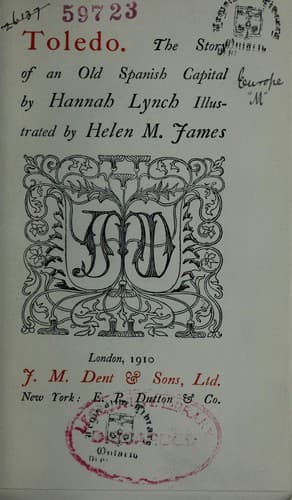
Toledo, the Story of an Old Spanish CapitalLynch, Hannah
History
Toledo, the Story of an Old Spanish Capital
Lynch, Hannah
Toledo (Spain) -- Description and travel; Toledo (Spain) -- History
The Tagus then, as now, was always the great natural charm of the town.
Like the Arno, it takes on every hue; some mornings just after dawn, it
is the palest blue, again is a still sleepy jade, or silver like a
curled mirror, and as stirless as it gives back the ardent flash of the
sunrays; or after sunset, when all the rich hues have faded from sky and
earth, and crimson and russet gold have waved into an indigo dusk, you
will see a white mist rise and travel in flakes from the bosom of the
enazured water over the dim landscape. Capricious as these cold or
fervent hours may be, the permanent colour of the tranquil untravelled
Tagus is yellow. All poets and writers see but the yellow in it, as in
the Tiber, though its blue and green and silvered hours are much more
beautiful. "Del dorado Tago ausente," sings the old _Romancero General_,
as far back as 1605, and continues to describe Toledo above her golden
river:
"Dize ay cristal del Tago
Que con murmurio entre arenas
Vais regando amenos sotos
de Agradable primavera.
[Illustration: THE TAGUS]
Hasto do bates los muros
de aquella cuidad soberbio,
tans alebrada en el mundo
Por tu artífio y nobleza.
Que entre peñas levantada
de inexpugnable firmeza,
Y de torres coronada
compitos con las estrellas.
Y luego vañas los prados
de tu elana y ancha vega,
Que de ninfas adornada
es nueva gloria en la tierra."
The most witching element in the enchantment of this river is its
stillness, its unfathomable, unbroken quietude. In the sixteenth century
it was navigable as far as Toledo, but the mills upon its banks are now
for ever silent; no traffic has deflowered its legendary charms; neither
boat nor barge cuts a way along its inactive waters. In an age when
every resource of nature is feverishly applied to the service of
commerce or luxury, there is something majestic in such uselessness.
When the wherry that plies sleepily from bank to bank floats into view,
the sight is a positive shock to artistic sensibilities. It seems an
idle desecration. Only the gold-seekers--symbol of eternal illusion,
ever nourished and ever elusive to the grasp of man, who builds fresh
illusions of the ashes of past deceptions--may continue to trouble its
wild untamed depths. So from time to time these children of tradition,
believing in the tale of its golden sands, go down to the reedy banks,
after an inundation, with sifters, and industriously gather up the sand
the river has flung from its bottom. They pour water over it, shake it
well, and then hungrily examine the grains that remain in the vain hope
of finding gold. Before Ponz's time the dean of the Church of the
Infantas was said to possess a piece of gold cast up by the Tagus, and
the complaint then was that many another piece had been carelessly
broken and scattered by the silversmiths. But Ponz doubts the golden
legend even so early as the last century. To explain the undoubted fact
Public-domain text, read in full here on John Shaqi.
Reviews
Reviews
No reviews yet
Be the first to share your thoughts on this work.
Elsewhere in the archive
Join the Discussion
Join the discussion
Sign in to leave a comment or review.
Sign InorCreate an account