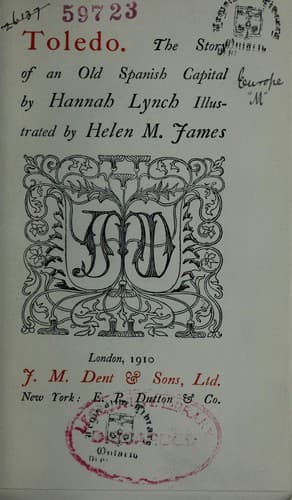
Toledo, the Story of an Old Spanish CapitalLynch, Hannah
History
Toledo, the Story of an Old Spanish Capital
Lynch, Hannah
Toledo (Spain) -- Description and travel; Toledo (Spain) -- History
that the river had at different times cast up treasure, he assumes that
in each reversal and exodus of race brought about by the evolution of
Toledo's history, Roman, Gothic, Moorish, Hebrew, and Christian, the
fugitives had the habit of burying near the river treasure in provision
for the expected return. Even this is no supposition to be scorned, and
adds to the romantic interest of the deserted Tagus.
[Illustration: MILL ON THE TAGUS]
Garcilaso de la Vega has chanted the golden charms of the Tagus, and
Cervantes writes of "the delicate works wrought by the four nymphs who,
from their crystal dwelling, lifted their heads above the waves of the
Tagus, and sat on the green meadow to work at those rich stuffs which
the ingenious poet paints for us, and which were fashioned of gold and
silk and pearls." Now, as then, like Lope the Asturian, aquadores
descend to the river-brink with their donkeys laden with water-jars,
which they fill below, and bridge the upward rocky paths shouting: _Agua
fresca_. The plays of Cervantes were acted at Toledo, which permitted
Lope de Vega, who lived then in the royal city, to make an ill-natured
reference to the great biographer of the ingenious Hidalgo in his
correspondence, and jeering at his plays, call him a "nescio."[15] Lope
little dreamed in his bitterness and jealousy that the "nescio" would
forever stand before posterity as the sole representative of Castillian
genius, and that the miserable little inn he dwelt in at Toledo would be
forever a spot of pious pilgrimage.
A more substantial source of wealth than the gold of Tagus was the
valuable lead and mineral mines of the Montes de Toledo, forty leagues
distance. In the bright days of civic power they belonged to the
municipality. King Fernando, the saint, sold them to the town for the
sum of 400,000 golden ducats, but the city little by little disposed of
a considerable part of this property to private individuals for
exploitation, and, like everything else, here the mines to-day have lost
in value.
In his few succinct pages on Toledo, Mr Street gives us a very excellent
bit of sober impressionism, which merits quotation: "The road from the
famous bridge of Alcántara, passing under the gateway which guards it
into a small walled courtyard, turns sharply to the right under another
archway, and then rises slowly below the walls until, with another sharp
turn, it passes under the magnificent Moorish Puerta del Sol, and so on
into the heart of the city.
Public-domain text, read in full here on John Shaqi.
Reviews
Reviews
No reviews yet
Be the first to share your thoughts on this work.
Elsewhere in the archive
Join the Discussion
Join the discussion
Sign in to leave a comment or review.
Sign InorCreate an account