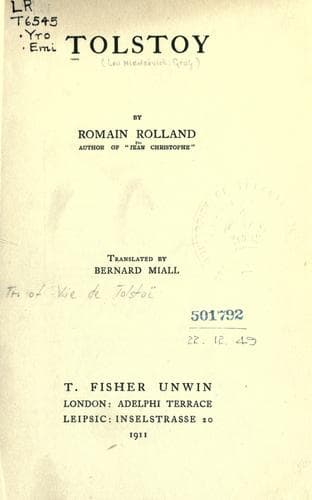
I have read, in the writings of distinguished critics, the theory
that Tolstoy owed the best of his ideas to the French romantics: to
George Sand, to Victor Hugo. We may ignore the absurdity of supposing
that Tolstoy, who could not endure her, could ever have been subject
to the influence of George Sand; but we cannot deny the influence of
Jean-Jacques Rousseau and of Stendhal; nevertheless, we belittle the
greatness of Tolstoy, and the power of his fascination, if we attribute
them to his ideas. The circle of ideas in which art moves and has its
being is a narrow one. It is not in those ideas that his might resides,
but in his expression of them; in the personal accent, the imprint of
the artist, the colour and savour of his life.
Whether Tolstoy's ideas were or were not borrowed--a matter to be
presently considered--never yet had a voice like to his resounded
throughout Europe. How else can we explain the thrill of emotion which
we all of us felt upon hearing that psychic music, that harmony for
which we had so long waited, and of which we felt the need? In our
opinion the style counted for nothing. Most of us, myself included,
made the acquaintance of Melchior de Vogüé's work on the subject of
the Russian novel[1] after we had read the novels of Tolstoy; and his
admiration of our hero seemed, after ours, a pallid thing. M. de Vogüé
spoke essentially as a man of letters pure and simple. But for our part
it was not enough to admire the presentation of life: we lived it; it
was our own. Ours it was by its ardent love of life, by its quality of
youth; ours by its irony, its disillusion, its pitiless discernment,
and its haunting sense of mortality. Ours by its dreams of brotherly
love, of peace among men; ours by its terrible accusation of the lies
of civilisation; ours by its realism; by its mysticism ours; by its
savour of nature, its sense of invisible forces, its vertigo in the
face of the infinite.
To many of us the novels of Tolstoy were what _Werther_ was to an
earlier generation: the wonderful mirror of our passions, our strength,
our weaknesses, of our hopes, our terrors, our discouragement. We were
in no wise anxious to reconcile these many contradictions; still less
did we concern ourselves to imprison this complex, multiple mind,
full of echoes of the whole wide world, within the narrow limits of
religious or political categories, as have the greater number of
those who have written of Tolstoy in these latter years: incapable
of extricating themselves from the conflict of parties, dragging him
into the arena of their own passions, measuring him by the standards
of their socialistic or clerical coteries. As if our coteries could be
the measure of a genius? What is it to me if Tolstoy is or is not of my
party? Shall I ask of what party Shakespeare was, or Dante, before I
breathe the atmosphere of his magic or steep myself in its light?
Public-domain text, read in full here on John Shaqi.
Reviews
Reviews
No reviews yet
Be the first to share your thoughts on this work.
Join the Discussion
Join the discussion
Sign in to leave a comment or review.
Sign InorCreate an account