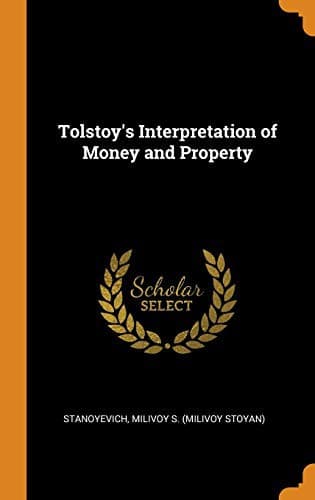
Tolstoy's interpretation of money and propertyStanoyevich, Milivoy S. (Milivoy Stoyan)
Philosophy
Tolstoy's interpretation of money and property
Stanoyevich, Milivoy S. (Milivoy Stoyan)
Money; Property; Tolstoy, Leo, graf, 1828-1910
There are several such examples of “ethical interpretation” of
economics among the most illustrious thinkers. They may be exculpated
for their disagreements only on the ground that they lived in times
when social science was in incumbent stage, when scientific ideas
were intermingled from one sphere of science into another. Good,
gentle Tolstoy, may also be pardoned for his “blunders of expression”
because he made them in his fanatic love of truth, and truth although
it is truth, does not always seem true, says a French proverb. To
treat the delicate and intricate complexity of money and wealth, and
never mislead, one should be a higher-man, a superman. But supermen
are not yet born in this sordid earth as fitly objected a well-known
philosopher.
FOOTNOTES:
[1] “If Tolstoy’s teaching is not systematic, two facts may be urged in
extenuation: his doctrines, so far as he expounds them, are consistent
in themselves”--says T. S. Knowlson in his biographical and critical
study on _Leo Tolstoy_, ch. VII, p. 143. [London, 1904].
[2] See J. W. Harper, _Money and Social Problem_, ch. V, sec. I, p. 98.
[3] _What Shall We Do Then_, ch. XIX, p. 127. [Wiener’s ed. 1904].
[4] _Loc. cit._, ch. XVII, p. 100.
[5] Cf. for instance, Plato, _Laws_, ch. XI, and Aristotle’s
_Politics_, bk. I, ch. 9; _Nicomachean Ethics_, by Aristotle, bk. V,
ch. 5.--Roman authors defined money as a “just medium and measure
of commutable things” _Moneta est justum medium, et mensura rerum
commutabilium_, quoted in H. C. Black, _Dictionary of Law_, p. 785.
[1891].
[6] _Wealth of Nations_, bk. II, ch. II.
[7] _Principles of Political Economy and Taxation_, ch. XXI.
[8] _Principles of Political Economy_, bk. III, ch. VII.
[9] _Principles of Social Science_, vol. II, ch. XXX, 1.
[10] _Die Philosophie Heracleitos des Dunkeln_, vol. I, p. 22. [1845].
[11] _Capital_, English ed. part I, ch. III.
[12] _The Purchasing Power of Money_, ch. II, ces. 1. [New York, 1911].
[13] D. Kinley, _Money_, a Study of the Theory of the Medium of
Exchange, ch. V, 6. [New York, 1913].
[14] Some excellent hints as to the money-commodity, compare H. White,
_Money and Banking_, bk. I, ch. I. [New York, 1908].
[15] Valuable suggestions on standard money, see W. A. Scott, _Money
and Banking_, ch. I, sec. I.--J. L. Laughlin, _The Principles of
Money_, ch. III.--J. B. Clark, _The Ultimate Standard of Value_,
in _Yale Review_, Nov. 1892, vol. 1, p. 258-74.--The same subject
is well treated by C. Manger in an article entitled “Geld” in the
_Handwoerterbuch der Staatswissenschaften_, bd. IV. [1900], and
L. Nasse, “Das Geld und Muenzwesen” in Schoenberg, _Handbuch der
Politischen Oekonomie_, bd. I. [1896].
[16] _What Shall We Do Then_, ch. XXI, p. 164. [Wiener’s ed.]
[17] _Id. Ibid._ ch. XXII, p. 161.
[18] _What Shall We Do Then_, ch. XXI, p. 158.
[19] _Op. cit._, p. 160.
[20] _Loc. cit._ ch. XXI, p. 159.
[21] _Id. Ib._ ch. XIX, p. 126.
[22] _Op. cit._ ch. XVIII, p. 122.
Public-domain text, read in full here on John Shaqi.
Reviews
Reviews
No reviews yet
Be the first to share your thoughts on this work.
Join the Discussion
Join the discussion
Sign in to leave a comment or review.
Sign InorCreate an account