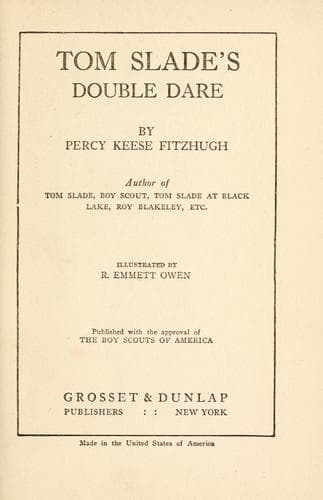
Boy Scouts of America -- Juvenile fiction; Camps -- Juvenile fiction
He approached the trunk and edged around it. As he did so a form moved
around the trunk also. Hervey paused. The pounding of his heart seemed
louder than the noises of the storm. In his throat was a queer burning
sensation. He could not speak. He could not stir. The dark form moved
again, ever so little....
CHAPTER VII
THE LIGHT THAT FAILED
The suspense was worse than any outcome could be, and Hervey, in another
impulse of desperation, took a step to the right, then quickly another
to the left. This ruse brought the two face to face. And in a flash
Hervey realized that he had little to fear from one who had tried so
desperately to escape his notice.
The figure was that of a young man, his raiment torn and disordered and
utterly drenched. He wore a plaid cap, which being pulled down over his
ears by reason of the wind, gave him an appearance of toughness which
his first words belied.
"You needn't be afraid," he said.
"I'm not afraid," said Hervey. "Who are you?"
"Did you hear some one scream?" the stranger asked.
"Scream? No. It was the wind, I guess. Are you lost, or what?"
"I want to get out of here, that's all," the young man said. "This place
is full of children screaming. Did you ever kill anybody?"
"No," said Hervey, somewhat agitated.
The stranger placed a trembling hand on Hervey's shoulder. "Do you know
a person can scream after he's dead?" he said.
"I don't know," said Hervey, somewhat alarmed and not knowing what to
say. "Anyway, I have to hurry; it's up to me to save some people's
lives. There's a bridge washed away along the road."
He did not wait longer to talk with this singular stranger, but thoughts
of the encounter lingered in his mind, particularly the young fellow's
speech about dead people and children screaming. As he hurried on,
Hervey concluded that the stranger was demented and had probably
wandered away from some village in the neighborhood. He had reason later
to recall this encounter, but he soon forgot it in the more urgent
matter of reaching the road.
He had now about half a mile of level country to traverse, consisting
of fields separated by stone walls. The land was soggy, and here and
there in the lower places were areas of water. These he would not take
the time to go around, but plunged through them, often going knee deep
into the marshy bottom. It was sometimes with difficulty that he was
able to extricate his leg from these soggy entanglements.
But he no longer needed the uncertain outline of that black mass amid
the surrounding blackness to guide him, for now the cheerful lights of
an isolated house upon the road shone in the distance. There was the
road, sure enough, though he could not see it.
"That's what Slady calls deduction," he panted, as he trudged on,
running when he could, and dragging his heavy, mud-bedraggled feet out
of the mire every dozen steps or so. Over a stone wall he went and
scrambled to his feet and hastened on.
Public-domain text, read in full here on John Shaqi.
Reviews
Reviews
No reviews yet
Be the first to share your thoughts on this work.
Join the Discussion
Join the discussion
Sign in to leave a comment or review.
Sign InorCreate an account