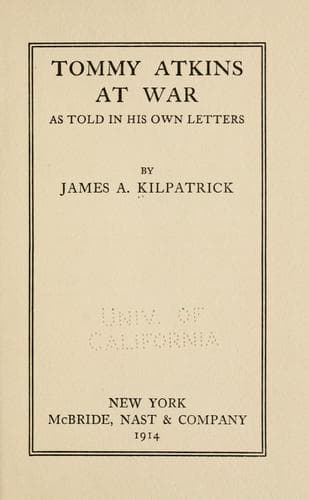
Tommy Atkins at War: As Told in His Own LettersKilpatrick, James Alexander
History
Tommy Atkins at War: As Told in His Own Letters
Kilpatrick, James Alexander
Great Britain. Army -- Military life; World War, 1914-1918
As showing the general feeling of the educated soldier, independent
altogether of his nationality, it is worth quoting two other
experiences, both Russian. Mr. Stephen Graham in the _Times_ recites the
sensations of a young Russian officer. "The feeling under fire at first
is unpleasant," he admits, "but after a while it becomes even
exhilarating. One feels an extraordinary freedom in the midst of death."
The following is a quotation from a soldier's letter sent by Mr. H.
Williams, the _Daily Chronicle_ correspondent at Petrograd: "One talks
of hell fire on the battlefield, but I assure you it makes no more
impression on me now than the tooting of motors. Habit is everything,
especially in war, where all the logic and psychology of one's actions
are the exact reverse of a civilian's.... The whole sensation of fear is
atrophied. We don't care a farthing for our lives.... We don't think of
danger. In this new frame of mind we simply go and do the perfectly
normal, natural things that you call heroism."
When the heroic things are done and there comes a lull in the fighting,
it is sweet to sink down in the trenches worn out, exhausted, unutterly
drowsy, and snatch a brief unconscious hour of sleep. Some of the men
fall asleep with the rifles still hot in their hands, their heads
resting on the barrels. Magnificently as they endure fatigue, there
comes a time when the strain is intolerable, and, "beat to the world,"
as one officer describes it, they often sink into profound sleep, like
horses, standing. At these times it seems as if nothing could wake them.
Shrapnel may thunder around them in vain; they never move a muscle. In
Mr. Stephen Crane's fine phrase, they "sleep the brave sleep of wearied
men."
III
HUMOR IN THE TRENCHES
One of the most surprising of the many revelations of this war has been
that of the gaiety, humor, and good nature of the British soldier. All
the correspondents, English and French, remark upon it. A new Tommy
Atkins has arisen, whose cheery laugh and joke and music-hall song have
enlivened not only the long, weary, exhausting marches, but even the
grim and unnerving hours in the trenches. Theirs was not the excitement
of men going into battle, nervous and uncertain of their behavior under
fire; it was rather that of light-hearted first-nighters waiting in the
queue to witness some new and popular drama.
Public-domain text, read in full here on John Shaqi.
Reviews
Reviews
No reviews yet
Be the first to share your thoughts on this work.
Join the Discussion
Join the discussion
Sign in to leave a comment or review.
Sign InorCreate an account