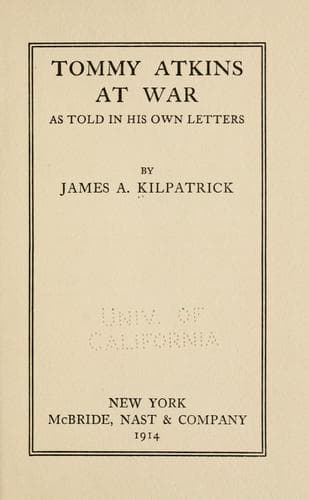
Tommy Atkins at War: As Told in His Own LettersKilpatrick, James Alexander
History
Tommy Atkins at War: As Told in His Own Letters
Kilpatrick, James Alexander
Great Britain. Army -- Military life; World War, 1914-1918
Bets are common in the trenches. Gunners wager about the number of their
hits, riflemen on the number of misses by the enemy. Daring spirits,
before making an attack, have even been known to bet on the number of
guns they would capture. "We have already picked up a good deal in the
way of German souvenirs," says one wag; "enough, indeed, to set a
decent-sized army up in business." The British Army, indeed, is an army
of sportsmen. Every man must have his game, his friendly wager, his
joke, and his song. As one officer told his men: "You are a lively lot
of beggars. You don't seem to realize that we're at war."
But they do. That is just Tommy's way. It is how he wins through. He
always feels fit, and he enjoys himself. Corporal Graham Hodson, Royal
Engineers, provides a typical Atkins letter with which to conclude this
chapter. "I am feeling awfully well," he writes, "and am enjoying myself
no end. All lights are out at eight o'clock, so we lie in our blankets
and tell each other lies about the number of Germans we have shot and
the hairbreadth escapes we have had. Oh, it's a great life!"
IV
THE MAN WITH THE BAYONET
Some military writers have declared that with the increasing range of
rifle and artillery fire the day of the bayonet is over. Battles, they
say, must now be fought with the combatants miles apart. Bayonets are as
obsolete as spears and battle axes. Evidently this theory had the full
support of the German General Staff, whose military wisdom was in some
quarters believed to be infallible--before the war.
As events have proved, however, there has been no more rude awakening
for the German soldiery than the efficacy of the bayonet in the hands of
Tommy Atkins. In spite of the employment of gigantic siege guns and
their enormous superiority in strength, though not in handling, of
artillery, the Germans have failed to keep the Allies at the theoretical
safe distance. They have been forced to accept hand-to-hand fighting,
and in every encounter at close quarters there has never been a moment's
doubt as to the result. They have shriveled up in the presence of the
bayonet, and fled in disorder at the first glimpse of naked steel. It is
not that the Germans lack courage. "They are brave enough," our soldiers
admit with perfect frankness, "but the bayonet terrifies them, and they
cry out in agony at the sight of it."
Public-domain text, read in full here on John Shaqi.
Reviews
Reviews
No reviews yet
Be the first to share your thoughts on this work.
Join the Discussion
Join the discussion
Sign in to leave a comment or review.
Sign InorCreate an account