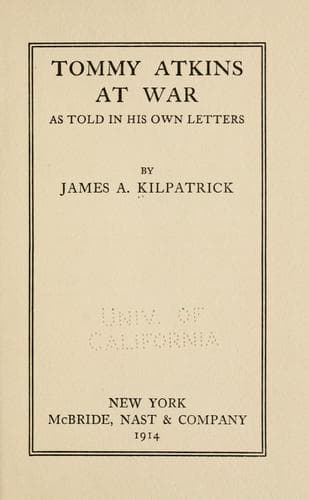
Tommy Atkins at War: As Told in His Own LettersKilpatrick, James Alexander
History
Tommy Atkins at War: As Told in His Own Letters
Kilpatrick, James Alexander
Great Britain. Army -- Military life; World War, 1914-1918
Some fine exploits are also given to the credit of the Black Watch.
They, too, were in the thick of it at Mons--"fighting like gentlemen,"
as one of them puts it--and the Gordons and Argyll and Sutherlands also
suffered severely. In fact, the Highland regiments appear to have been
singled out by the Germans as the object of their fiercest attacks, and
all the way down to the Aisne they have borne the brunt of the
fighting. Private Fairweather, of the Black Watch, gives this account of
an engagement on the Aisne: "The Guards went up first and then the
Camerons, both having to retire. Although we had watched the awful
slaughter in these regiments, when it was our turn we went off with a
cheer across 1,500 yards of open country. The shelling was terrific and
the air was full of the screams of shrapnel. Only a few of us got up to
200 yards of the Germans. Then with a yell we went at them. The air
whistled with bullets, and it was then my shout of '42nd forever!'
finished with a different kind of yell. Crack! I had been presented with
a souvenir in my knee. I lay helpless and our fellows retired over me.
Shrapnel screamed all around, and melinite shells made the earth shake.
I bore a charmed life. A bullet went through the elbow of my jacket,
another through my equipment, and a piece of shrapnel found a resting
place in a tin of bully beef which was on my back. I was picked up
eventually during the night, nearly dead from loss of blood."
Perhaps the most dashing and brilliant episode of the fighting is the
exploit of the Black Watch at the battle of St. Quentin, in which they
went into action with their old comrades, the Scots Greys. Not content
with the ordinary pace at which a bayonet charge can be launched against
the enemy these impatient Highlanders clutched at the stirrup leathers
of the Greys, and plunged into the midst of the Germans side by side
with the galloping horsemen. The effect was startling, and those who saw
it declare that nothing could have withstood the terrible onslaught.
"Only a Highland regiment could have attempted such a movement," said an
admiring English soldier who watched it, and the terrible gashes in the
German ranks bore tragic testimony to the results of this double charge.
The same desperate maneuver, it may be recalled, was carried out at
Waterloo and is the subject of a striking and dramatic battle picture.
Though all the letters from men in the Highland regiments speak
contemptuously of the rifle fire of the Germans, they admit that in
quantity, at least, it is substantial. "They just poured lead in tons
into our trenches," writes one, "but, man, if we fired like yon they'd
put us in jail." The German artillery, however, is described as "no
canny." The shells shrieked and tore up the earth all around the
Highlanders, and accounted for practically all their losses.
Public-domain text, read in full here on John Shaqi.
Reviews
Reviews
No reviews yet
Be the first to share your thoughts on this work.
Join the Discussion
Join the discussion
Sign in to leave a comment or review.
Sign InorCreate an account