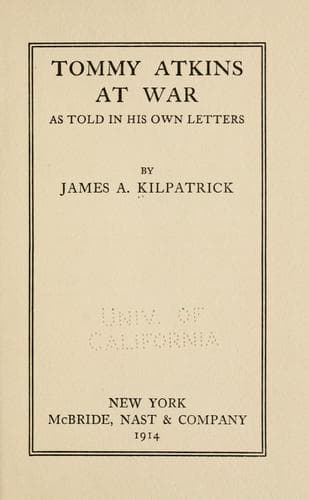
Tommy Atkins at War: As Told in His Own Letters — John Shaqi
Tommy Atkins at War: As Told in His Own LettersKilpatrick, James Alexander
History
Tommy Atkins at War: As Told in His Own Letters
Kilpatrick, James Alexander
Great Britain. Army -- Military life; World War, 1914-1918
The saving of the guns is always an operation that calls for
intrepidity, and many exploits of that kind are related. Lance-Corporal
Bignell, Royal Berks, tells how he saw two R.F.A. drivers bring a gun
out of action at Mons. Shells had been flying round the position, and
the gunners had been killed, whereupon the two drivers went to rescue
the gun. "It was a good quarter of a mile away," says the witness, "yet
they led their horses calmly through the hail of shell to where the gun
stood. Then one man held the horses while the other limbered up. It
seemed impossible that the men could live through the German fire, and
from the trenches we watched them with great anxiety. But they came
through all right, and we gave them a tremendous cheer as they brought
the gun in."
Sir John French in one of his despatches records that during the action
at Le Cateau on August 26th the whole of the officers and men of one of
the British batteries had been killed or wounded with the exception of
one subaltern and two gunners. These continued to serve one gun, kept up
a sound rate of fire, and came unhurt from the battlefield.
Another daring act is described by W.E. Motley, R.F.A. "Things became
very warm for us," he says, "when the Germans found the range. In fact
it became so hot that an order was passed to abandon the guns
temporarily. This is the time when our men don't obey orders, so they
stuck to their guns. They ceased their fire for a time. The enemy,
thinking our guns were out of action, advanced rapidly. Then was the
time our men proved their worth. They absolutely shattered the Germans
with their shells."
Some gallant stories are told of the Royal Engineers. One especially
thrilling, is given in the words of Darino, a lyrical artist of the
Comedie Francaise, who joined the Cuirassiers, and was a spectator of
the scene he describes. A bridge had to be blown up, and the whole place
was an inferno of mitrailleuse and rifle fire. "Into this," he relates,
"went your Engineers. A party of them rushed towards the bridge, and,
though dropping one by one, were able to lay the charge before all were
sacrificed. For a moment we waited. Then others came. Down towards the
bridge they crept, seeking what cover they could in their eagerness to
get near enough to light the fuse. Ah! it was then we Frenchmen
witnessed something we shall never forget. One man dashed forward to his
task in the open, only to fall dead. Another, and another, and another
followed him, only to fall like his comrade, and not till the twelfth
man had reached the fuse did the attempt succeed. As the bridge blew up
with a mighty roar, we looked and saw that the brave twelfth man had
also sacrificed his life."
Public-domain text, read in full here on John Shaqi.
Reviews
Reviews
No reviews yet
Be the first to share your thoughts on this work.
Join the Discussion
Join the discussion
Sign in to leave a comment or review.
Sign InorCreate an account