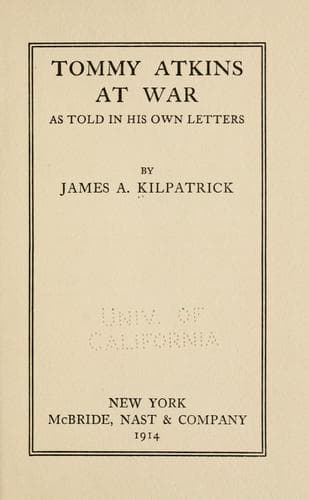
Tommy Atkins at War: As Told in His Own LettersKilpatrick, James Alexander
History
Tommy Atkins at War: As Told in His Own Letters
Kilpatrick, James Alexander
Great Britain. Army -- Military life; World War, 1914-1918
Some of the earliest letters from the soldiers present distressing
pictures of the poor, driven refugees, fleeing from their homes at the
approach of the Germans, who carry ruin and desolation wherever they go.
"It is pitiful, pitiful," says one writer; "you simply can't hold back
your tears." Others disclose our sympathetic soldier-men sharing their
rations with the starving fugitives and carrying the children on their
shoulders so that the weary mothers may not fall by the way. "Be
invariably courteous, considerate, and kind" were Lord Kitchener's words
to the Army, and these qualities no less than valor will always be
linked with Tommy Atkins' name in the memories of the French and Belgian
people.
They will never forget the happy spick-and-span soldiers who sang as
they stepped ashore from the troopships at Boulogne and Havre, eager to
reach the fighting line. These men have fought valiantly, desperately,
since then, but their spirits are as high as ever, and their songs still
ring down the depleted ranks as the war-stained regiments swing along
from battle to battle on the dusty road to Victory.
II
SENSATIONS UNDER FIRE
It is said of Sir John French that, on his own admission, he has "never
done anything worth doing without having to screw himself up to it."
There is no hint here of practical fear, which the hardened soldier, the
fighting man, rarely experiences; but of the moral and mental conflict
which precedes the assumption of sovereign duties and high commands.
Every man who goes into battle has this need. He requires the moral
preparation of knowing why he is fighting, and what he is fighting for.
In the present war, Lord Kitchener's fine message to every soldier in
the Expeditionary Force made this screwing-up process easy. But to men
going under fire for the first time some personal preparation is also
necessary to combat the ordinary physical terror of the battlefield.
Soldiers are not accustomed to self-analysis. They are mainly men of
action, and are supposed to lack the contemplative vision. That was the
old belief. This war, however, which has shattered so many accepted
ideas, has destroyed that conviction too. Nothing is more surprising
than the revelation of their feelings disclosed in the soldiers'
letters. They are the most intimate of human documents. Here and there a
hint is given of the apprehension with which the men go into action,
unspoken fears of how they will behave under fire, the uncertainty of
complete mastery over themselves, brief doubts of their ability to stand
up to this new and sublime ordeal of death.
Rarely, however, do the men allow these apprehensions to depress or
disturb them. Throughout the earliest letters from the front the one
pervading desire was eagerness for battle--a wild impatience to get the
first great test of their courage over, to feel their feet, obtain
command of themselves.
Public-domain text, read in full here on John Shaqi.
Reviews
Reviews
No reviews yet
Be the first to share your thoughts on this work.
Join the Discussion
Join the discussion
Sign in to leave a comment or review.
Sign InorCreate an account