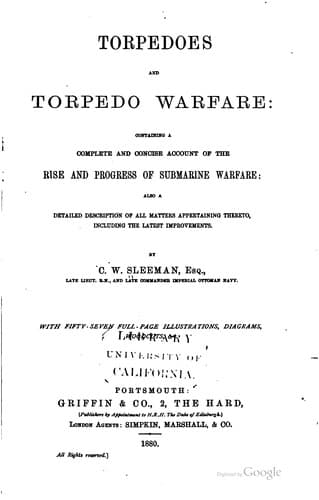
Torpedoes and Torpedo Warfare: Containing a Complete and Concise Account of the Rise and Progress of Submarine WarfareSleeman, Charles William
History
Torpedoes and Torpedo Warfare: Containing a Complete and Concise Account of the Rise and Progress of Submarine Warfare
Sleeman, Charles William
Torpedoes
"These vessels are each 85 feet long with 11 feet beam, and draw,
when fully equipped for service, an average of 3 feet of water. They
are strongly constructed of steel, and are fitted with compound
surface condensing engines capable of indicating 420 horse power. The
high pressure steam cylinder of these engines is 12-1/2 inches in
diameter, and the low pressure 21-1/2 inches, both having a 12 inch
stroke. These boats are at present known by their builders' numbers,
one being No. 419 and the other No. 420. The former is propelled by a
three-bladed screw, 5 feet 6 inches diameter and 5 feet pitch; and the
latter by a two-bladed screw of similar proportions. Messrs. Yarrow
adopt supplementary engines for driving the air pump, circulating
pump, and feed pumps; they consider this plan preferable to that of
working these pumps direct off the main engine, as is sometimes done.
One advantage in having separate pumping engines is that, whether the
vessel is in motion or stationary, a powerful means is available for
pumping her out, should the necessity arise. It is estimated by her
builders that if the air pump and circulating pump were both utilised
for this purpose, the water could be pumped out as fast as it could
enter either of these vessels through one hundred holes made in the
skin by Martini-Henry rifle bullets. If this is the case, these craft
may be deemed safe from sinking so long as their machinery is working
efficiently. The boiler is of the locomotive type, placed in the
forward part of each vessel, and has a closed stoke hole. In connection
with the boiler a very important improvement has been introduced by
Messrs. Yarrow. This consists in a means of rendering the closed
stoke hole safe for the men in the event of the collapse of a boiler
tube--a contingency which cannot be absolutely guarded against. Its
efficiency was proved beyond all question upon a previous trial of
one of these boats. This was No. 419, which was tried on the 24th of
May last under the supervision of the Admiralty officials. Upon that
occasion an accidental rupture of one of the boiler tubes occurred
nearly at the close of the runs over the measured mile, which so far
had been very successful. When the boiler tube gave way the steam
rushed out of the foremost hatchway from the compartment in which the
smoke box end of the boiler is situated, and soon after from the two
funnels. The men in the stoke hole, however, being shut off from the
boiler, were uninjured, and remained at their post several minutes
after the first outburst of steam. The accident, although an untoward
event, was considered by the Admiralty officials as affording a highly
satisfactory proof of the efficiency of Mr. Yarrow's invention.
Public-domain text, read in full here on John Shaqi.
Reviews
Reviews
No reviews yet
Be the first to share your thoughts on this work.
Elsewhere in the archive
Join the Discussion
Join the discussion
Sign in to leave a comment or review.
Sign InorCreate an account